
LOT # 14713
GILT BRONZE CAST TRIPOD CENSER MOUNTED WITH MYTHICAL BEASTS
大明稀世國寶鎏金精雕金猊宣德爐
scroll to zoom
Dimension:
Height: 10 7/8 in (27.5 cm) Ear-to-Ear Length: 9 1/8 in (23.0 cm) Rim Diameter: 5 7/8 in (14.8 cm) Weight: 4812.0g
Estimated Price:
$1500000 - $2000000
Ming Dynasty period.
Provenance:Mr. Osborne, a famed Asian antique collector, operated an antique store within Pacific Asia Museum at Pasadena, and he was also the consultant for the museum. He passed away more than ten years ago. The current owner of the gilt bronze censer is an artist, painter, and philosopher, specializing in collecting Xuande period censers. He immigrated to United States from Taiwan as First Preference EB-1 with Extraordinary Ability. The censer has been appraised and identified by multiple specialists, all agree that this gilt bronze censer was dated before Mid Ming Dynasty period, with supporting evidence listed in the accompanying document of the censer on the catalog.
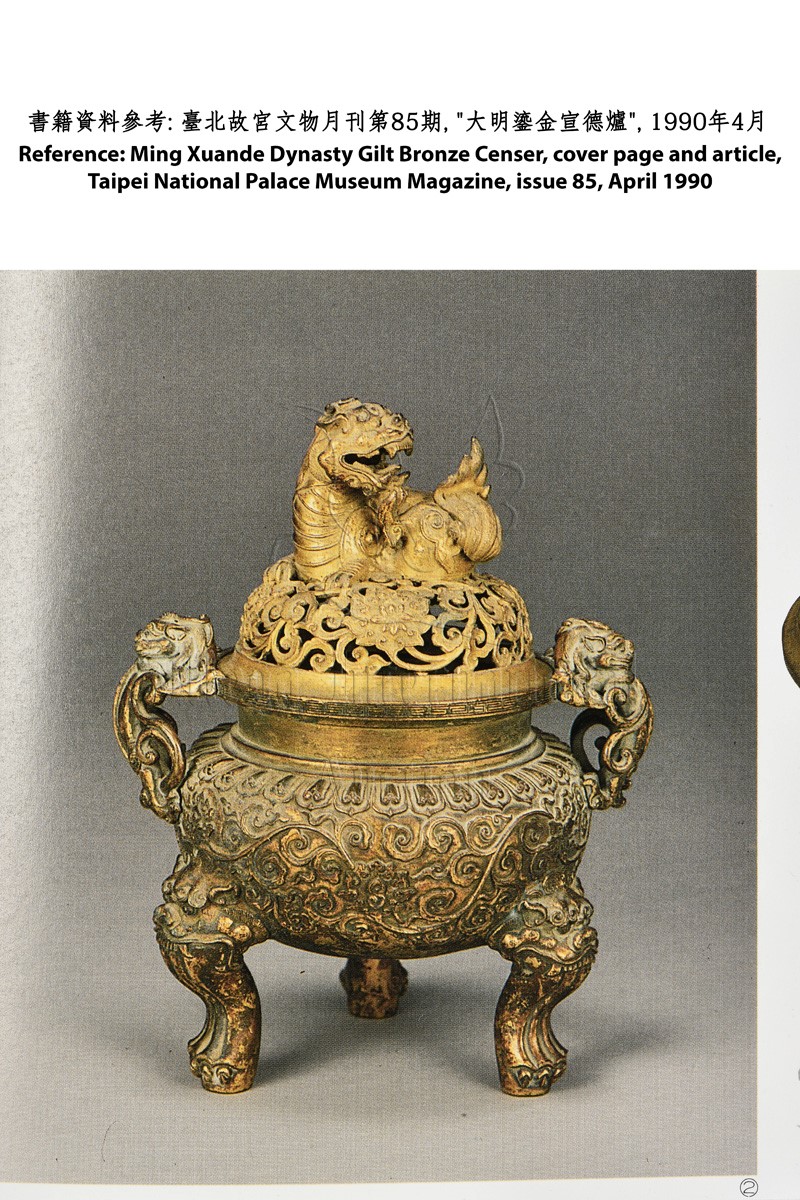
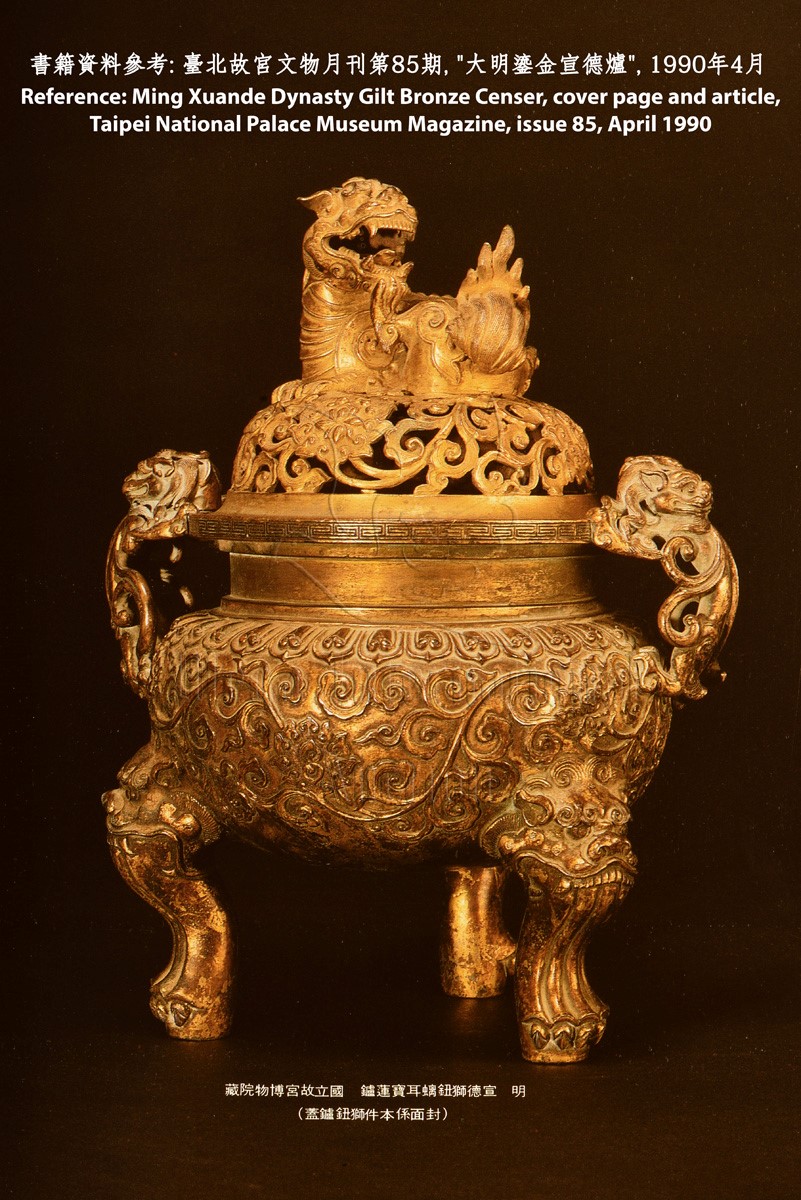
Reference: Ming Xuande Dynasty Gilt Bronze Censer, cover page and article, Taipei National Palace Museum Magazine, issue 85, April 1990
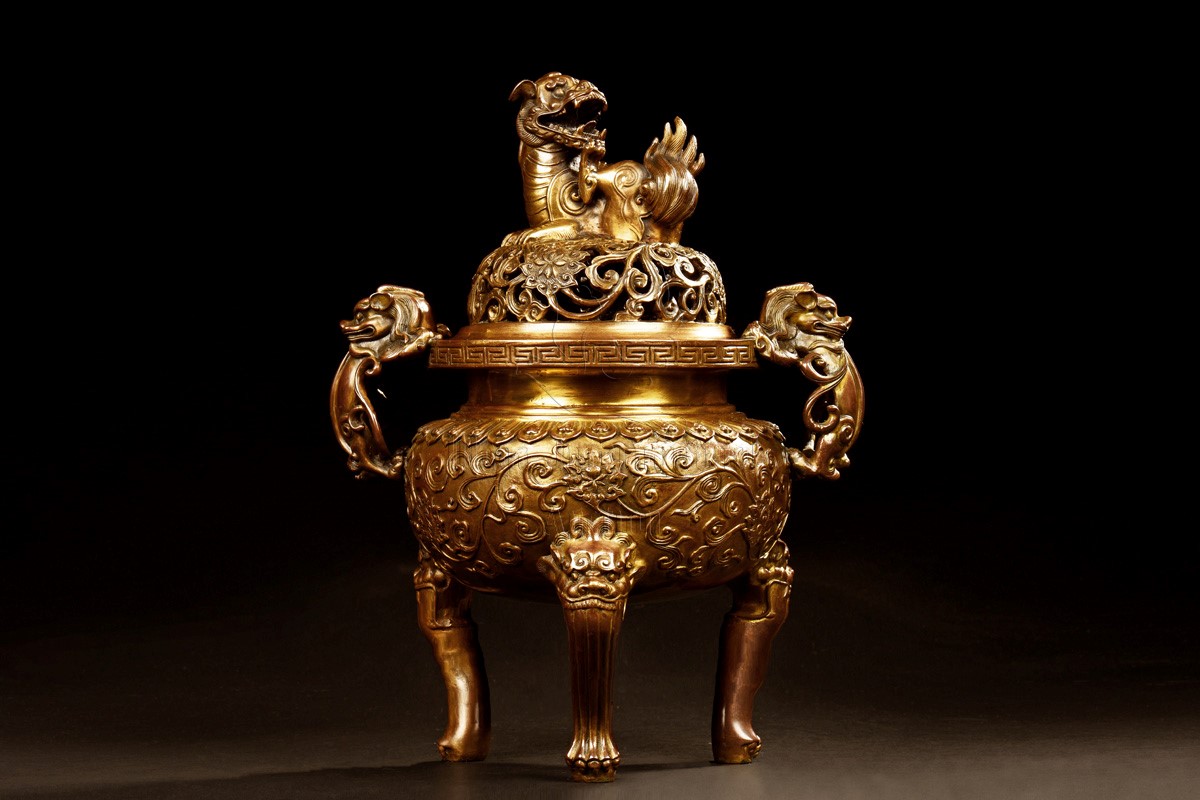
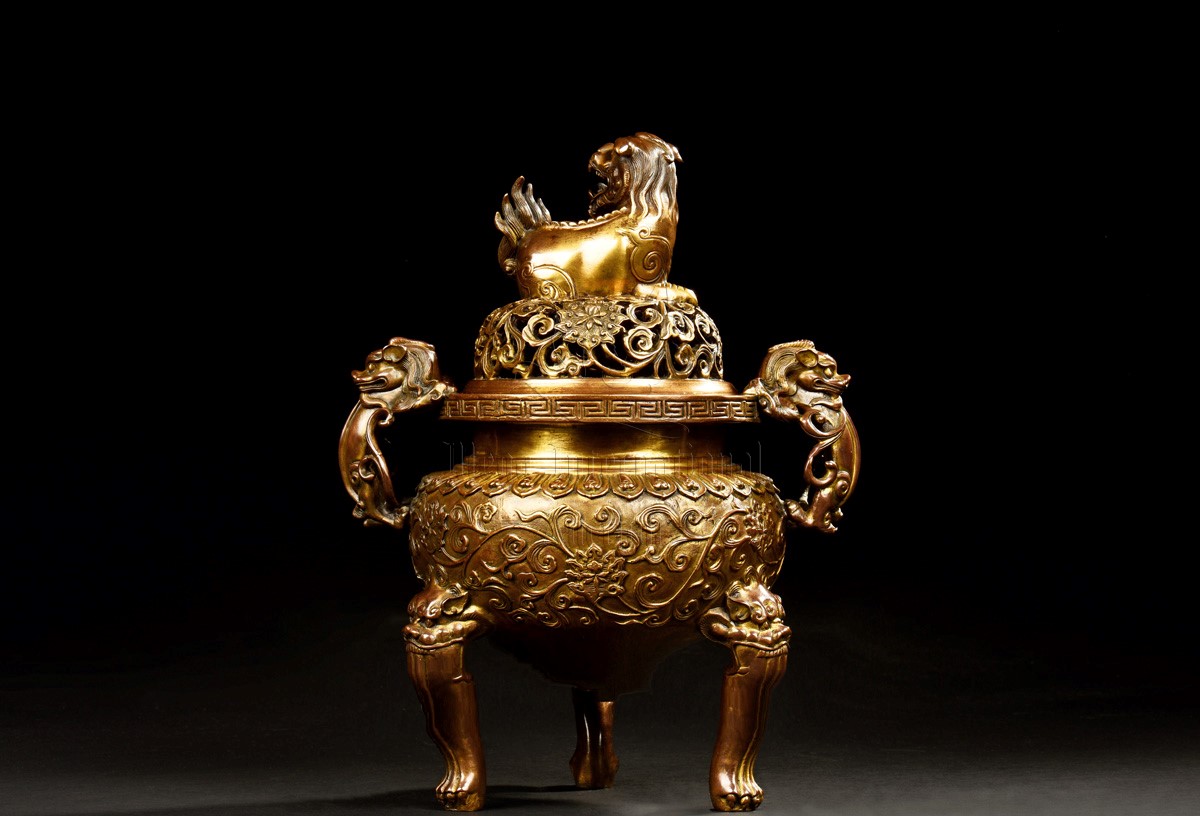
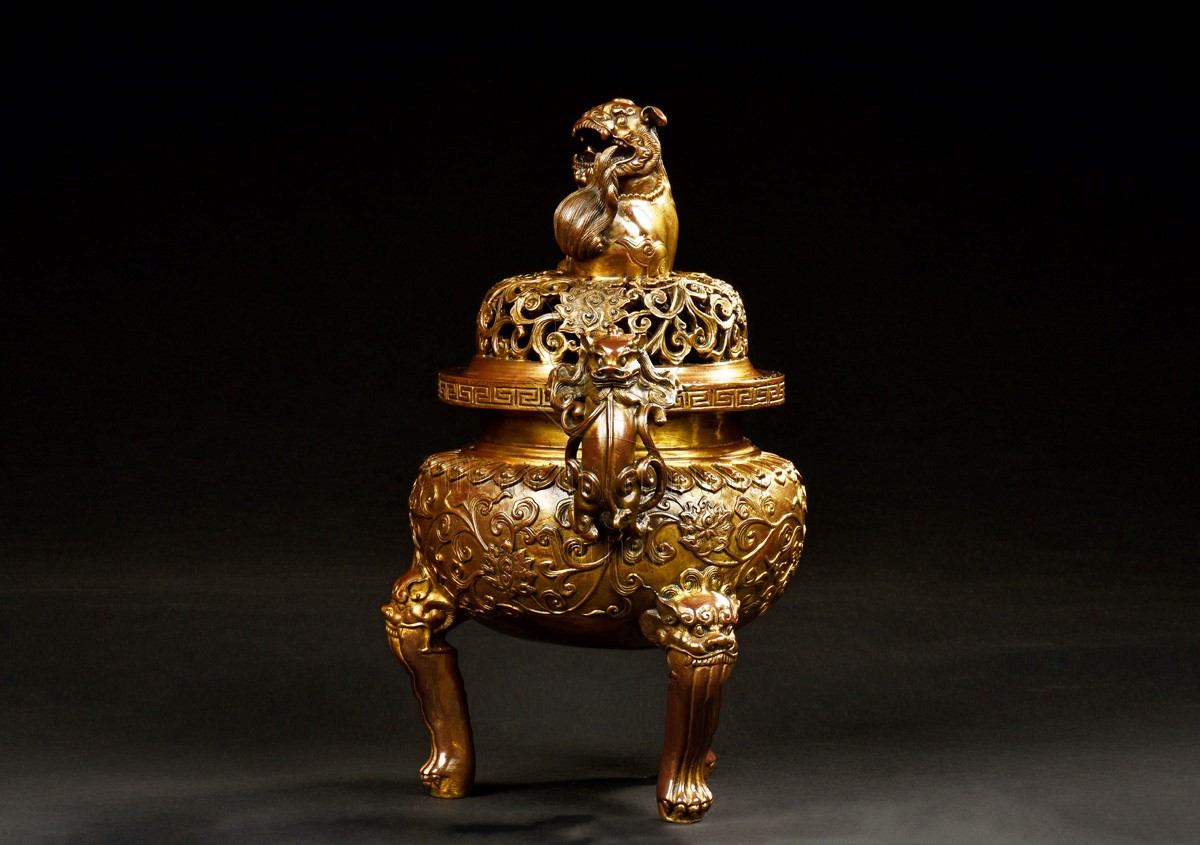
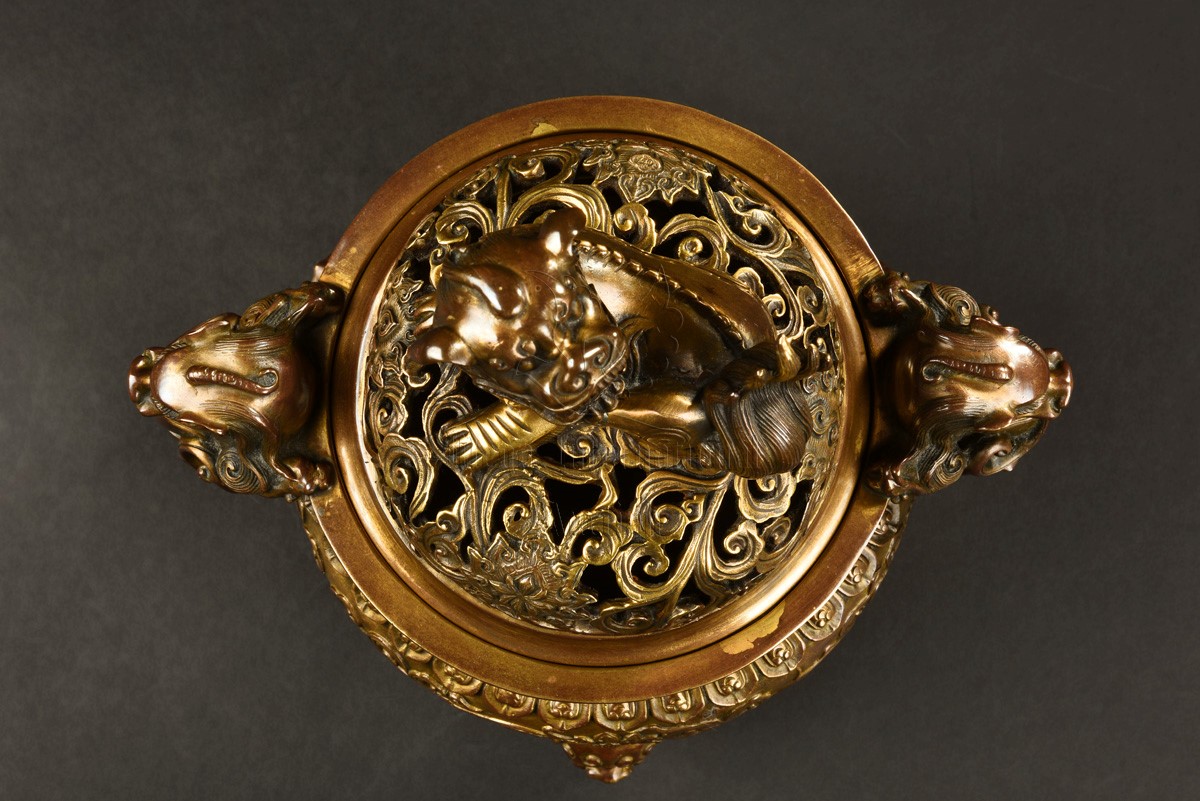
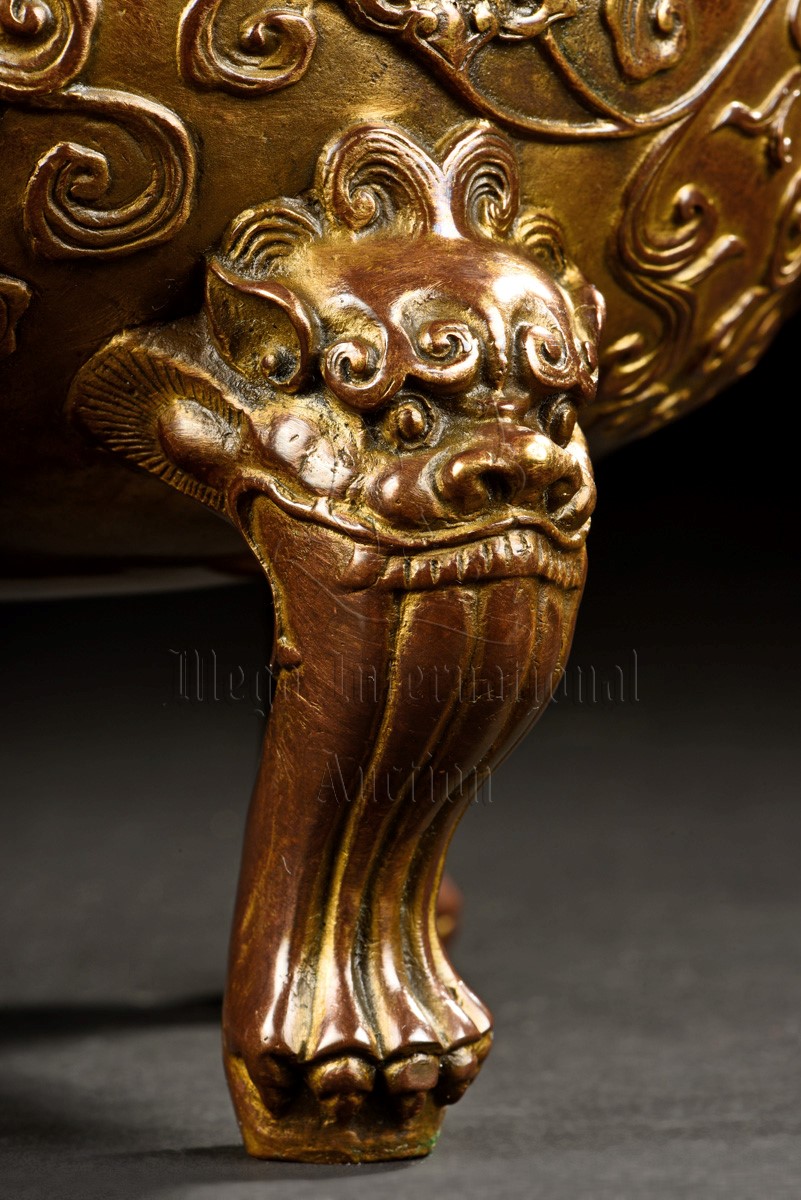
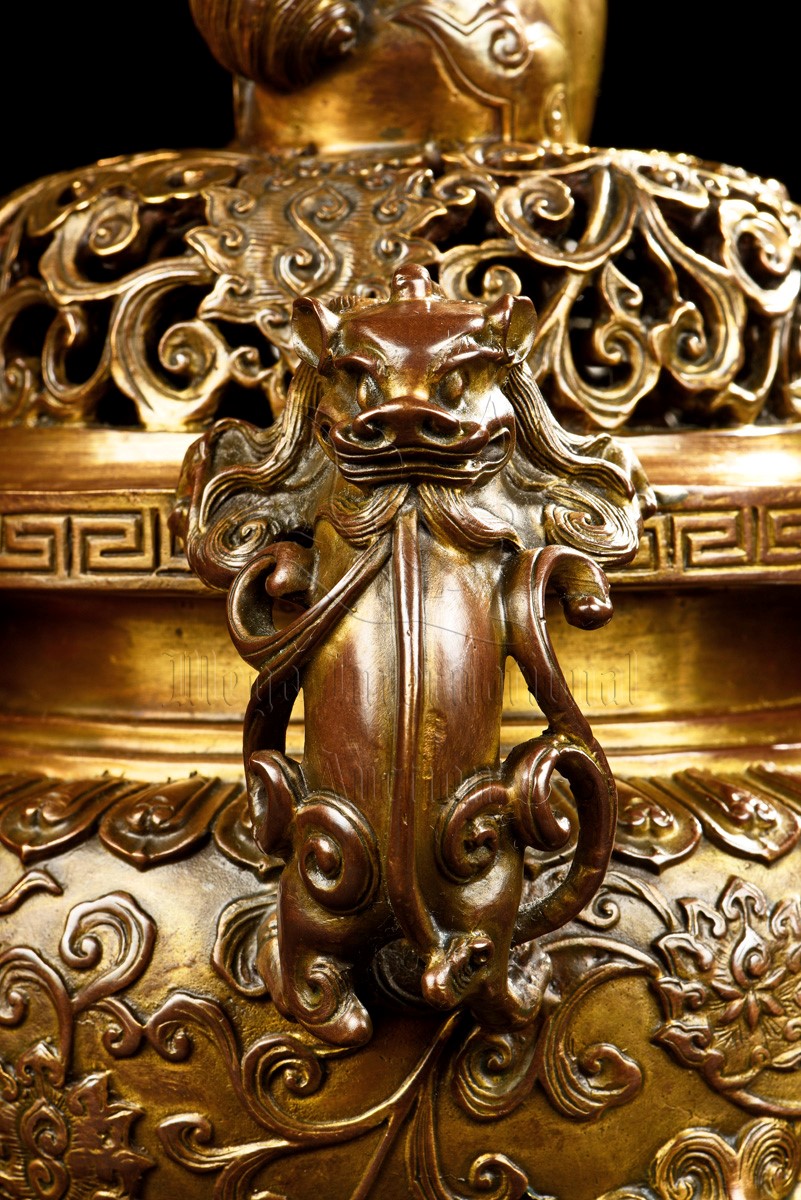
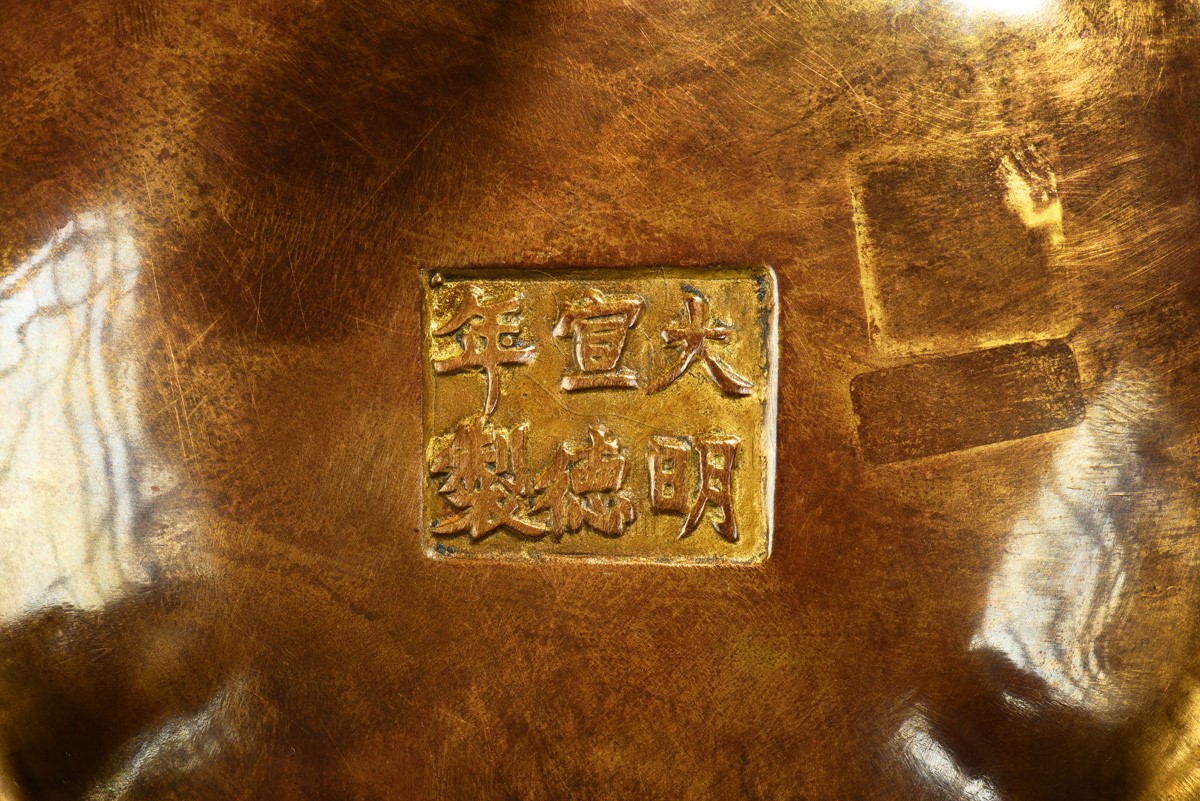
The gilt bronze cast censer is of bulbous form, stands on three beast legs extending from beast masks, body depicts scrolling flowers and vines beneath lappet band patterns, two vivid mythical beast handles mounted on the sides, with openwork carved domed lid on top, mounted with a recumbent mythical beast, bottom bears six character XUANDE reign mark.
大明稀世國寶鎏金精雕宣德爐
詠大明金猊爐
1. 一代江山傳奇物, 千古絕唱宣德爐,
堂堂四千八百克,威重如山鎮明府。
2. 雕工造極光藝道,幽古神韻耐百讀,
金猊燦燦辟邪偽,真氣煌煌護人主。
3. 烈火熊熊十二鍊,華潤瑰麗越凡俗,
通體已成玫瑰金,不與世間爭有無。
4. 滄桑歷盡國事非,一身風骨如當初,
珠璣散空可再起,國寶錯失緣難復。
5. 天才只為文明生,一旦乘龍驚四處,
一爐淨香射斗牛,萬峰朝盼新日出。
6. 天才只為正義生,人間有難勇支助,
一爐淨香沖天際,宇宙為心萬神扶。
(引自洛杉磯子焜長詩)
1990年4月,台北故宮文物月刊第85期的封面,刊登了大明鎏金宣德爐的精彩圖片,並由當時的銅器部主任及宣爐專家張光遠先生撰文論述,題目是:鎏金精雕大明宣德爐,由此引起了海内外宣爐愛好者熱烈關注!張先生意謂台北故宮歷來所珍藏多件的宣爐當中,以此件為頂極巨製,並標示為宣德年作品,乃宣德年代鑄爐藝匠之登峰傑作!實不虛言也!
事隔近三十年,而今勝緣降臨,本爐於玆赫赫登場,可謂橫空出世而先後輝映矣!本爐乃私人收藏家在1980年代中,高價購自美國白人Osbon收藏家手中。Osbon先生是在1950年代買入的,他精於銅爐鑑賞,研究多年而甚有心得!本爐也,在明代嘉靖名士祝枝山傳摹的【宣德彛器圖譜】中,名為【金猊爐】,本爐無論從型制、膚色、紋飾、鎏金、内膛及銅質,皆基本與台北故宮的相同,只有尺寸重量與款識,略有些微出入,雖整體内外相似度達百分之八、九十,但仍存有不同點而獨具風華的特色,此所以稀貴也!
以下關於本爐將作進一步論述:
A. 【金猊爐】即鎏金的狻猊宣德爐,明代人稱狻猊,形似獅子,性好煙火,故多坐於香爐蓋上,是中國自唐代以來的神獸。唐代銅境的狻猊造形,有的頭上長角,增其威猛,狻猊有雙角和獨角之別,而獨角狻猊是結合了獅子、辟邪和麒麟于一身,成爲中國的守護神獸!本爐是獨角狻猊,與台北故宮的一樣,安坐爐蓋上,獅頭回顧,舌翹口張,雙目圓凸,炯炯有神。左右前足趴伸,足作四爪,左後足舉起而以爪搔下巴,右後足則隱藏而只露出三足。獅頭髮毛分成五股,垂貼頸上,頭頂中央長出一根彎勾形的直紋枝角,雙耳向左右平伸,脖子作橫式曡弧紋,獅身之背脊關節凸顯,露出十一節,獅尾之毛,理成七股,左右兩股較短而收卷,中間五股並排而往上翹起,口與腮形又像龍嘴,全身體態靈動壯美!
爐身以雙螭分左右攀立於腹部及口沿上,作爲爐耳,螭頭則反顧背部,頭頂有一彎鈎形長角,髮毛理成四股,分左右垂于前足上,兩耳後豎,鼻形與獅鼻同,嘴則閉合,下巴有鬚作兩小股而分開兩邊,螭身扁圓形,前二足之爪分別攀附于爐口上,後二足之爪則攀附于爐腹上,全形優美生動,以上所述細節(包括所指數目),本爐與台北故宮的,完全吻合!
再者,三隻爐足表現得極爲遒勁有力!足部之上端作獅頭形,威風凜凜,頂上無角,髮分四股,左右迴旋,雙耳後展,獅口賁張,齒腮近似龍嘴,腿有五條凸起直紋,下連五爪至足根,足底接近圓形,腿部強健而不臃腫,虎虎生風!
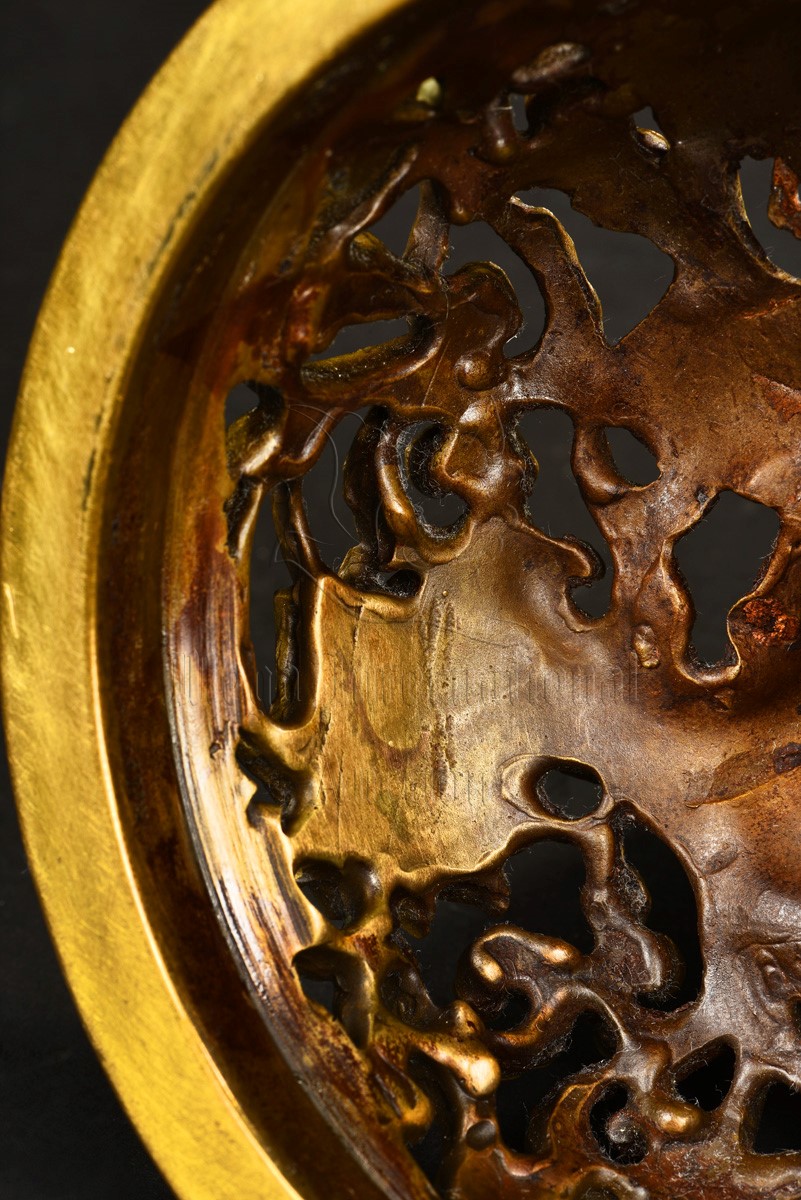
又爐蓋表面為浮雕四朵蓮花紋, 安置於前後左右四方,有三朵作十枚花瓣, 背面一朵卻有十二枚花瓣,四朵蓮花之間,穿插波浪枝莖,有如巻雲迴繞,亦如仙衣之飄帶,分佈於花莖之間,其鏤空處,香煙可繚繞而出矣!
還有爐身口沿飾雲雷紋一道極精緻,口沿下,束頸無紋,頸下腹上雕飾三十三片蓮瓣紋,腹面則浮雕纏枝蓮花紋,其蓮花為六朵,纏枝蓮紋乃明代藝風,繁褥精美,以上所述細節包括所有數目,本爐均與台北故宮的,一一吻合!
B. 本爐氣勢非凡,巧奪天工而情韻迴盪,宣爐中的極品,當之無愧!明代宣爐多做素面,而此金猊爐卻精雕細刻,逸群絕倫,加之通體鎏金,其內蘊精光,而英華發外,可謂在明清兩代銅爐中,宛若眾星拱月,萬目所歸也!本爐黃金成色經測定約為22k,歷經古人長期斷斷續續的焚香使用,留下了煙塵已深入肌裡,形成一層氧化膜。前代人又經過長期焚供後的清潔或濯洗,故鎏金有少許部分已逐漸剝蝕,手容易撫摸擦拭到的地方,則包漿舒潤亮麗,死角處則有灰漬顏色,整體金水濃淡及包漿的自然分佈,質感與時間過渡極為自然,符合數百年滄桑的氧化特徵,這是造假者無法模仿到位的!也是現代人使用電腦3D技術仿製無法辦到的!
C. 此大明金猊爐皮色之美,乍觀之,泌人心脾,久視之,如入勝境,徘徊無已!
1、所謂鎏金厚足且黃中泛紅,此明代標準色也!
2、所謂大氣磅礴且圓融溫馨,此明爐渾厚優雅之特徵也!
3、所謂歷史積澱卻清潤如液,此包漿瑩厚之故也!
4、所謂金水剝蝕卻風骨畢露,此宣銅真跡,玫瑰金也!
5、所謂曲線流暢而質精色麗,此明爐之國色天香也!
6、所謂雄健瑰放而絢爛四溢,此明爐之英豪傳奇也!
7、所謂剛柔並濟又幽古奧遠,此明爐獨有神韻也!
8、所謂肌膚細膩又穩重如山,此明爐一代風華也!
本爐之美,有如上述,歷代傳承至今,其皮色、包漿、形韻皆在在顯示明代稀世寶物之超卓雋美,是真是偽之辨,已判若鴻溝矣!本爐整體皮色與台北故宮的極相似,後者除展示期外,多半密藏于箱中,故看起來略新,本爐包漿則較後者腴潤,但鎏金部分,兩者皆有微小剝落,本爐則略多于後者,這可能是古人在數百年的傳承中,有過長期或不定期的焚香使用與擦拭,及長久曝露于大氣中所致!也因此,整體之包漿韻味比後者腴厚而潤亮也!細觀本爐之皮色尚未經機器抛光或用強烈的擦銅劑打磨。歐美人士收藏金銅藝術品,喜歡從事清理及抛光來展現金貴的美麗光澤,在蘇富比與佳士德拍賣的鎏金銅件中,經常可見到品相乾淨如新的古物,與華人審美觀念略異!
本爐在容易撫摸到的部位,以及沒有花紋而較平整的地方,包括内縮的頸圈、獅鈕(狻猊)的背後、爐口、底面與螭身等等,皆顯得特別瑩潤。歷經好幾代滄桑的養護,本爐已出現極其罕見的玻璃光蠟皮,它融合了數百年的氧化灰漬,整體神韻高古而莊嚴瑰麗,大明皇家貴氣,籠罩全屋,不可擋也!大明吉金燿采,縱對看終日而淪肌浹髓,又不可擋矣!
D. 本爐底面中央之銘文為【大明宣德年製】六字款,字體較一般的款識小,刻字也較淺,字跡雖有楷書筆意,但沒有沈度的楷書精良,字風俊逸,別具一格,此乃【縮格体】也!據張光遠先生稱:明代的爐款,並非沈度字體可獨攬,另有歐陽詢的楷書、一般的篆書及其他,不一而足!只不過沈度的較普遍,以致後世仿製的也最多!另外也有一種可能,不排除有皇家或大臣的親筆在内,因未署名,較難認定也!
明代縮格体款識之銅爐,目前文博界認爲年代處於宣德至嘉靖之間,類似明代瓷器的空白期,數量稀少!如2015年7月天津博物館舉辦大型的明清銅爐特展,共計三百餘件,其中僅有特少數的縮格体銅爐,年代定在明中期!
台北故宮的鎏金獅爐(金猊爐)銘文,同樣是六字款,字跡不大,刻字不深,據張光遠先生稱:其六字陽文筆劃略有高低不平及刻損現象,而銘文底面也有剔削未平痕跡,故銘文是通過直接浮雕腊模所鑄成的!絕非字模印製,若字模印製,銘文底面較平坦,無剔削不平現象。又稱:字體乃出自另一書家之手(不可考)也!
本爐之款識,用手撫摸,字略有高低,卻甚滑潤而毫無扎手或澀刺之感,顯示包漿厚實,且與台北故宮的情況一樣,均屬直接浮雕蠟模而後鑄成的!兩者字跡筆畫略有差別,但相差不大,兩者亦均非一般流傳之沈度楷書也!由於縮格体款識不多見於明爐中,應屬稀罕之品!其珍貴可知矣!
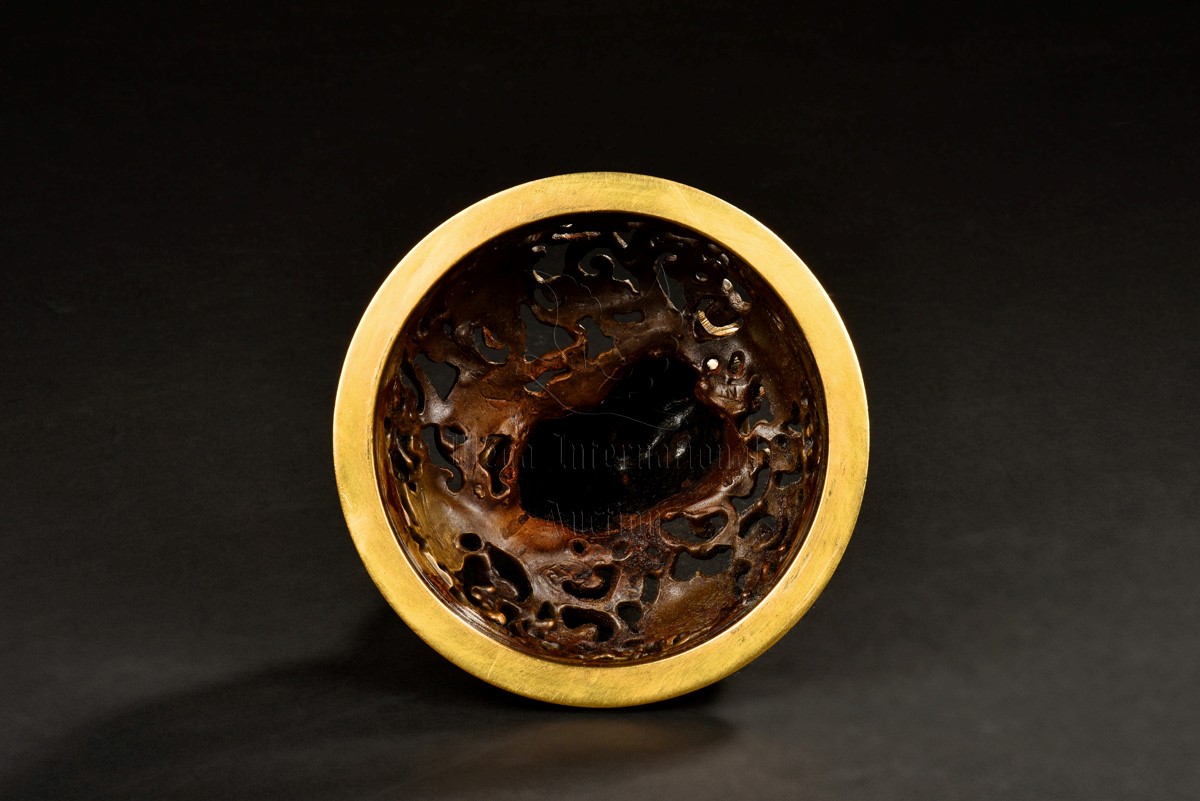
E. 本爐寳蓋與爐口緊密相貼,嚴絲合縫,周正規整,工細法精。寳蓋内,獅鈕中空,内膛三足則各有一孔洞,與台北故宮的相同,但本爐寳蓋内面以及整個内膛,皆全部鎏金,惟被一層密實貼骨的煙漬所掩蓋,不停地強力擦落煙漬則金水煥然而出矣!然台北故宮的獅爐其寳蓋内面與内膛,皆未鎏金(張光遠述),此乃兩者大不同處也!本爐通身内外皆得金水,極度珠光寶氣,實不同凡響!可見其不惜工本而隆重鑄就,若非皇家特製,焉得如此大費周章?再者,本爐内膛因金水厚實,從不生銹,而台北故宮的,卻早已銅綠斑斑矣!此又為兩者之不同處也!
本爐内膛無晚明之放射性跳刀痕或旋削紋的特徵,與台北故宮的情況一樣,年代如前所斷,至少是明中期或之前的官造爐無疑!今揆之於明清兩代冶金工藝,其通體内外皆鎏金的精品爐,真可遇不可求矣!此非國之重器而何?
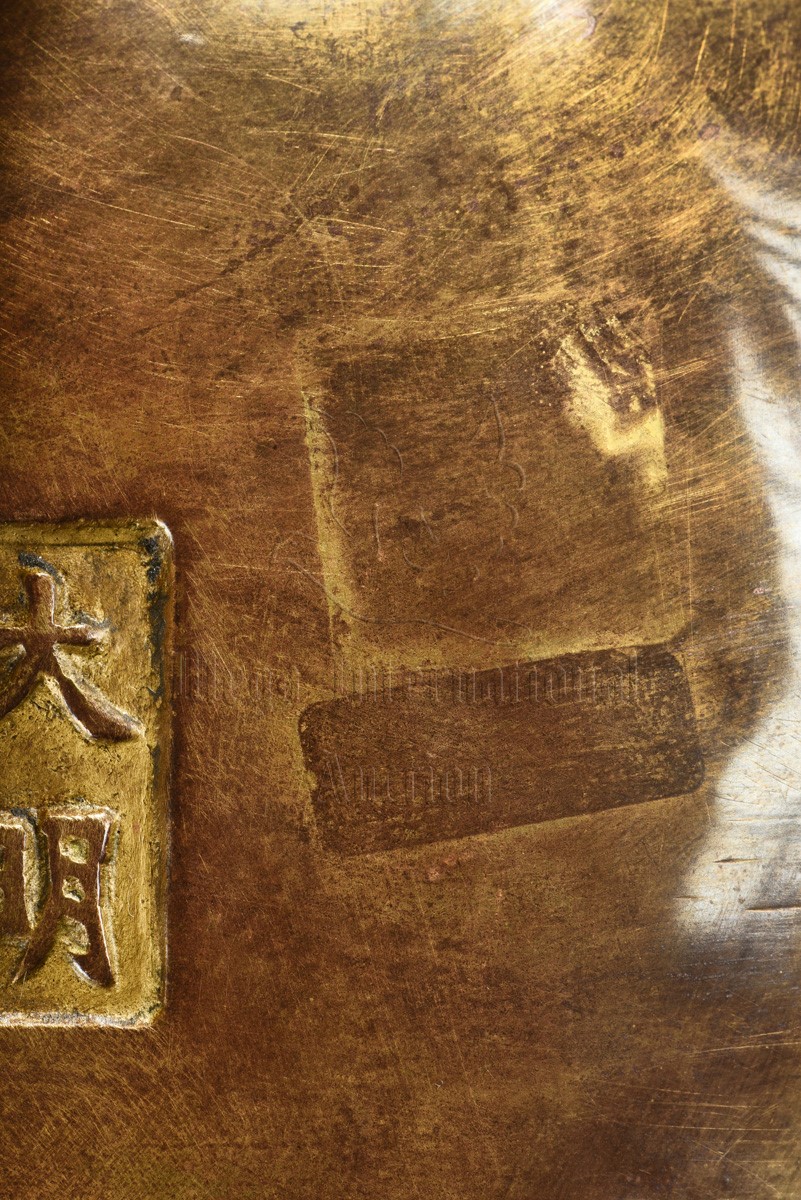
F. 本爐底面的款識右邊,有一大一小兩個方格補丁,大的是正方形,小的是長方形,並排一起,長度約近兩公分。此方格補丁,乃原始補鑄痕跡!銅質因特別精錬,在灌模流淌時,偶爾會出現漏銅現象,故需補鑄。這種補鑄並非缺失,正説明其工藝精湛,質量不凡的表現!本爐具有兩個方格補丁(台北故宮的沒有),手指撫之極爲平順瑩潤而毫無疙瘩,補鑄之銅質與爐胎完全一致,渾然天成而整體融合。内膛底部有一道微微凸起之痕跡,卻毫無傷損,這可能是灌模補鑄時所留下的。又本爐既為官造爐,故原始補丁亦即明宮御用監(相當於清宮造辦處)的原作坊所補鑄的,其質量之高及修飾之美,絕非後代所能做到!自明亡(1644年)後,宮廷藝匠四散,罹此國破家亡之際,迭遭生死離別之痛!入清(17世紀下半葉)後,清廷造辦處雖廣募人才,卻獨缺此術,故整個清代之銅爐看不到方格補丁的風格,明朝鑄爐之一代奇技,惜至清初時,便已失傳,迄今長達近四百年,此乃文博界公認的事實!江山板盪,天才凋零,今日能目睹本爐,令人感慨思念而珍惜不已!明代人之冶鑄風格,借此可以紀錄而長留後世,何幸如之!
明代銅器留有方格補丁的,目前所知不多,除宣爐外,尚有金銅佛等,方格補丁有專家推測可能配合特殊的焊接技術完成,因明代早期焊接技術已運用成熟,至景泰年間,更大量施展于銅件的成品上,尉為奇觀。焊接技術的提昇,使明代冶金工藝有突破性的進展!其在藝術品的組合銜接上,不僅牢固,且看不到斷絲、殘渣或接痕。如早在1416年明早期所建的金殿中,許多銅件多用焊接組合而成,技術遠勝宋元兩代!除焊接外,尚有鑄接,有時交相使用,如何令藝術品更牢更美,明人真的是運用之妙,存乎一心矣!
這種方格補丁在銅器上的記號,顯示了明代以前冶金(包括焊鑄)的高超技藝,即使至今,古物造假者,仍皆無法仿製。本爐兩處補丁,不僅不是缺陷,反而是明風的不朽傑作,標誌著大師藝匠的苦心孤詣與飛軒絕跡,更成爲宣爐斷代的標準器!自古國之重器,天涯難覓,亦惟有雄才偉士,亦惟有俊彥奇葩,足以承擔以延續文化香火也!
如子焜(大明爐得主)詩云:
千山爭盼祥雲到
萬朵繚繞在奇峰
天道有靈酬善功
寳爐颯颯傲東風
G. 有非常之人,才有非常之擧,有非常之思,才有非常之行,明代宣爐之製作,爲何在數千年中華文明流傳的銅器中,獨佔鰲頭,號稱銅中之金,尤其質量勝過赫赫有名的青銅器,即使到了今日的太空時代,銅爐仿造,依然在明爐之下,無法逾越!讓人深思也!明代銅爐整體的製造水平超越了清代(乾隆御製除外),但並非所有的明爐皆銅中之金也!勿入誤區!所謂銅中之金,必達八錬以上(明人以六錬為宣爐之基本),此時鋅、錫與熔點較低的其他金屬原料已逐漸消失氣化,分子加速震蕩而相融于銅礦之中,錬就之後,呈現的色澤是燦爛的玫瑰色,如現代歐美流行的18K紅金(以下簡稱玫瑰金)。這種質量才能在長年使用及在焚香的高溫下,耐磕碰、耐腐蝕、耐穿孔、耐傷損等等,經得起一代又一代的文化香火傳承!故明代之玫瑰金爐,實乃東方之聖物也!遠遠超過一般之銅佛、銅瓶、銅盤等,蓋冶錬次數不同,境界懸殊,如同聖人與凡人之比,其内在氣質,判若天淵矣!這都是一般人不太能了解的!也因爲不太了解,人生才會遇人不淑,陷入苦難的誤區!
宣德爐是從最近三十年來,才慢慢逐漸被研究清楚,很像元青花,也是近世在宣爐熱之前,才風起雲湧,受到萬人矚目的!有關宣德爐的種種鑑賞知識,請參考本公司2017年6月17日,拍賣明代象首耳爐時,有近萬字長篇的精細論述,喜好宣爐者,必讀也,在此不必重覆!(Mega International Auction)
本爐之口徑14.8公分,耳距23公分,高27.5公分,重量4812克,台北故宮的鎏金獅爐(金猊爐)則高29.7公分,口徑15.8公分,重量4310克,尺寸與重量兩者略爲不同!後者體積稍大于前者,但重量較輕!兩者同時在金水剝落處,可明顯看出隱伏的深玫瑰色,而非黃銅顔色!其他還有小地方,隨著時間氧化的自然過渡,金水剝蝕後的包漿覆蓋,瑩潤中透露出古銅赤色的痕跡,其銅胎絕非黃銅,而是赤色的銅合金,正如張光遠所言:【爐身局部因氧化而呈現黑褐色,露出的銅胎,可見泛紅的銅色】。明代宣爐銅胎在多年前尚不太定性,直到最近(2018年)文博界才大多認定,明代精品爐,銅胎必赤!!銅胎若是黃銅,則表示精錬度的質量還不高,且比重較輕!黃銅香爐大多出自清中期之後也!
玫瑰金爐乃銅器之頂峰,也是有明一代冶金工藝的代表作,它要耗費許多的鑛料,以及長時間的工程,始克畢就!在明代時,宣爐已經很貴,且玫瑰金爐是斤斤計較的,通常每增加500克(一斤),即跳上一個級數,譬如同等級爐1000克與2000克之別,不是乘以兩倍價格,經常是五倍十倍在起跳,因爲明代較重較大的上等好爐早已成爲珍稀之品,全世界偌多收藏家爭相收購、追捧,僧多粥少之下,自然未來行情,欣欣可期也!
本爐與台北故宮的,不僅銅胎均為赤色,且比重也比一般的更壓手!一般到代的黃銅爐跟玫瑰金爐,只要上手一掂,立刻分明,假不了的,玫瑰金永遠就是玫瑰金,縱拿其他銅佛、銅瓶也難以相比!再説壓手感有三、六、九等不同,不是所有壓手的銅爐,就是玫瑰金爐,勿入誤區!
若以本爐之尺寸、重量卻高達4812克,衡之於明清兩代同樣大小的銅爐,可謂推倒一時豪傑,罕有其匹!即使台北故宮的獅爐,亦膛乎其後矣!今以明人的鑄爐法而論,本爐比後者略小,然重量卻多出五百克,此非達十二錬不為功,而只有十二錬的特級凝重感和壓手感,方足以獨領風騷,藝驚士林!其他任何宣爐,皆無可逾越,身份不同,價便懸殊。明爐之重量即分量,未有重量平凡,而能擠進玫瑰金之行列也!同樣,未有凡人之氣質思想,而能升入神聖之光華世界也!
經研究推斷,台北故宮的獅爐,已臻乎八煉的境界,明代的官造鎏金爐一般都不低於八煉,亦即八煉以上的玫瑰金,才鄭重地飾以鎏金,雖非絕對,然亦十不離八九!故明代的金猊爐至少八煉以上,如皇家專用則必達十二煉,十二煉之極品,帝王自享,不贈與外人也!
本爐單手難擧,即使雙手端捧,亦頓感吃力,壓手感特強,有一股往下的強勁拉力,不易支撐,覺得極為渾厚又凝重!然銅質不可作僞,加鉛鑄造或用紅銅灌鑄,離玫瑰金層級甚遙矣!玫瑰金爐必重必美,必精必潤,必貴必稀,非其他銅爐可企及也!銅中之金,決非虛言!
再者,本爐三足的底部,經擦除塵漬後,雖有磨損,金水仍厚,並未剝落,蓋因足底受空氣氧化影響較少,歷經數百年,雖有摩擦痕,猶金光燦燦,宛若當初!所謂【帝室宣爐,足踏黃金】,此之謂也!本爐三足赫然鼎立,用手推之,不易動且不易倒,穩如泰山,遠望之,鋒發韻流而氣宇軒昂,近觀之,夭矯不羣而威風凜凜,大明金猊爐之美,言不盡矣!其匠心之獨運,淋漓盡致且絲絲入扣,又讓人思不盡矣!
H. 目前藏於拉薩羅布林卡的鎮寺之寶- 大慈法王緙絲唐卡,乃宣德九年,皇帝賞賜給西藏大慈法王的珍寶。在唐卡的左上方,赫然出現一座三足狻猊爐,而此狻猊並非雙角,應是獨角狻猊。2018年2月份開始,此件珍稀唐卡伴隨其他重要文物,將在北京首都博物館展覽至7月份,經博物館清晰拍攝原物比對,此狻猊爐全身是金黃色,與唐卡中大慈法王頭部聖光的顏色一致,故應屬通體鎏金的隆重御賜品,而非黃銅製件,證明宣德年間即有金猊爐之製作,可見金猊爐自宣德以降,已源遠流長矣!此件唐卡作為宗教意義上的圖像表現,是細膩而完全寫實的,相當於那個時代的照片一樣,當時金猊爐在皇家心目中的分量,誠非比尋常矣!
又本爐在明代宣德爐譜中,屬於中大型之巨製,明代各朝宣德爐之作,以小型居多。因玫瑰金爐成本太昂貴,一般都在兩千克上下,超過三千五百克以上,存世量已甚稀少,早為收藏家納入囊中,不隨便也不輕易讓出!!玫瑰金爐因為冶煉次數較多,淘汰雜質及氧化物也較多,故質量上與銅瓶、銅盤、銅佛等等,早已拉開了一大段距離!如銅瓶(明代)的含鋅值約百分之12至15之間,而明代玫瑰金爐必在百分之五以下,不可同日而語,銅胎之精密度既有差異,所表現出來的珠光寶色、凝重感、壓手感、細膩度、耐用度等,則完全不同矣!明代宣德爐號稱銅中之金,是具備充足理由的!與其他銅製品不可等量齊觀!銅中之金、炳耀古今,絕非虛言也!清代嘉慶道光以後,爐胎含鋅量多超過了百分之二十二以上,故呈現黃銅色澤,不僅不能與清三代相頡頏,較之明代,更不能相提並論矣!銅爐表面可造假,銅質(銅胎)不能作僞,明代銅爐具有宣德以來前無古人之傳統精煉的大匠精神,故能誕生熠熠不朽的璀璨紅金(玫瑰金爐),可以說,那正是明朝一代又一代偉大的技藝接棒,可以說,那正是明朝一代又一代偉大的香火傳遞! 銅中之金,豈偶然也!如同每個人的靈魂,在大地上,湏経千百年的淬鍊,始能從物質界中破殼而出,綻放人性的光輝而得到昇華,故認知要深睿,命運不以一世因果作論斷,眼界必宏闊,進化不以塵寰百年為局限一樣,一旦悟道,則不再永遠于大地穿梭爬行,必向宇宙高處的真實璀璨世界升進!!浩瀚無涯涘矣!
如子焜“金爐耀采”之詩云:
換骨湏得真仙丹 脫胎必從質量鍊
銷盡凡渣無塵點 留下紅金驚世間
金猊爐 香正熱 千流萬派我獨艷
金猊爐 辟邪惡 浩氣蓬勃蕩雲天
本爐尺寸較一般宣爐碩大,分量又極其感人,且通身內外皆鎏金,論其飽滿度,十足也!論其精美度,十足也!論其罕見度,亦十足也!至於年度,則為明宮特製官造爐,又十足也!富有的收藏家,一生致力追求曠世珍奇,如同覺悟的高端人,一生致力追求真正聖者一樣的重要!由此,天下神品之桂冠,本爐當之無愧矣!
I. 本爐保存相當完善,毫無裂痕及傷損,僅有在放大鏡下,可以看見的少許小磕碰,品相極爲完美,真正明代尺寸如此碩大而通體鎏金的金猊爐,全世界擁有的,目前不會超過十件,金猊爐在收藏界奉若神尊,是罕見而極其難得的稀世國寶!
金猊爐除罕見之外,即使明代的所有高檔爐,也已成爲當今最稀少的熱烈收藏品項目,且數量遠遠不及瓷器、銅佛及書畫各項的百分之一!近幾年,宣爐雖獲追捧,但價格亦遠遠落後于瓷器及書畫諸項,這是由於宣爐乃最近二十年才竄起,已成方興未艾的熱門古董,起步雖慢,並不表示可見的將來,不能領先群倫。明清數百年間,好銅爐經常價高于好瓷器,屬於文房之首的珍寶,古時已極爲考究而愛惜有加矣!明代宣爐價格目前偏低,必有朝一日,宣爐終將高步云衢,在世界上揚眉吐氣,此屈指可待也!
近十年由於電腦設計圖及3D技術提升,許多古代銅爐都遭仿製,包括金猊爐在内,但明眼人一看便知其造假!其神韻、銅質、皮色、古意、綫條及包漿,仍有明顯差距,難以模仿到位,當一般工藝品擺飾則可,當古董則詐矣!僞矣!不可不知也!
J. 今本爐隆重推出,論型制,論皮色,論款識,論質量,皆上上之選,宛若曠世奇才而神資並妙,亦如龍躍雲津而推群獨步!本爐之珠光寶氣,通體内外鎏金,富麗堂皇且貴氣逼人,可謂震鑠八方,冠絕一切矣!這是全世界五十年來,所有拍賣公司最高檔的明代宣德爐之一,百年難遇!本爐集真、精、新、奇、稀、美,六絕于一身,明宮至珍,妙絕時物,非稀世國寶而何?雖不必定為其為真宣(宣德年間所製),亦直追真宣之風骨矣!雖不必定其為真宣而疑似真宣,亦直追真宣之品貌矣!宣德之功,千古風華,舉世驚艷也!
Ming Xuande Dynasty National Treasure Exquisitely Carved Gilt Bronze Censer
On the Taipei National Palace Museum Magazine April 1990 issue’s cover was a magnificent Ming Xuande Dynasty gilt bronze censer, with corresponding article by Xuande censer expert and National Palace Museum Bronze Department head Zhang Guangyuan titled: Gilt bronze exquisitely carved Ming Xuande Dynasty censer, caught the attention of many Xuande censer collectors’ eyes. In the article, Mr. Zhang mentioned that out of all the many Ming Xuande Dynasty bronze censers in the National Palace Museum, this particular censer was considered as one of the best and was definitely a masterpiece from the Ming Xuande Dynasty period.
Around thirty years after the article, this very similar Ming Xuande Dynasty National Treasure Exquisitely Carved Gilt Bronze Censer is appearing for the first time for the collectors worldwide. This censer was purchased by a private collector from the American collector Mr. Osbon during the 1980’s, who was a Chinese bronze ware expert, first obtained it during the 1950’s. This censer, according to Ming Jiajing Dynasty’s book “Xuande Bronze Vessels Catalog” by famous writer Zhu Zhishan, this censer is named “Golden Mythical Ni Lion Censer”, and this censer’s style, color, patterns, gilt, interior, and bronze type, all pretty much is the same as the censer in National Palace Museum, only the size, weight, and mark are slightly different. Although it is 80-90% similar, it also has unique traits, making it very valuable.
I will now describe the censer in detail below:
A. “Golden Mythical Ni Lion Censer”, or gilt bronze Suan Ni Xuande censer. During Ming Dynasty period, Xuan Ni is a mythical beast that looks like a lion, with ferocious temper, and thus it was usually resting on top of censer lids, and was one of the famed mythical beasts since the Tang Dynasty period. On the bronze mirrors of Tang Dynasty period, Xuan Ni’s has differing designs, some with single or double horns on the back of the head, making it even more mighty. Single horn Xuan Ni is a combination of lion, Pi Xiu, and Qi Lin, served as a Mythical Guardian Beast of China. This censer features a single horn Xuan Ni, the same as the one in National Palace Museum, seated on top of the lid cover, the head turned sideways, with bulging eyes and wide open mouth. The front legs each with four-claw paw, resting in front of the body. The left back leg raised to chin level as if it is scratching its itch, the right back leg hidden from the views. The mane hair separate into five strands, resting on its neck and back. A single horn extends from the center of its head, curves elegantly towards the back. Two ears leveled, the neck has layered ring patterns, the back shows eleven spinal segments, the tail separated into seven strands, the left and right two strands were short and curled, middle five strands raised upwards, the mouth and chin looked similar to a dragon’s mouth, and the entire body beautifully carved.
The censer’s body mounted with two Chilong on the left and right side, attached to the rim on top as censer ears, the Chilong’s head turned backwards, with a curled single horn on top of its head, the manes separated into four strands, covering left and right side of front paw, two ears curled back, the nose shaped similar to a lion’s nose, two front paws mounted on the rim, the back two legs mounted on the waist of the censer, beautifully carved. All the details above, including numbers, are identical to National Palace Museum’s censer.
In addition, the three censer legs look extremely sturdy and strong. The legs extends from lion masks, each without horns, the manes separates into four strands, curls to the sides, two ears hangs back, mouth wide open, the teeth and chin looks like dragon’s mouth, the extended legs each has five raised patterns, extends all the way to the bottom of foot, the foot’s bottom is almost rounded shape, showing the legs as strong and lean.
The censer’s surface relief carved with four scrolling lotus flower patterns, each located on the body with similar distance, three of the flowers have ten flower petals, while the remaining flower has twelve petals. Flower vines and petals intertwined between the flowers, shaped similar to stylized clouds and robe bands.
On the rim of the censer covered with scrolling yunlei pattern, no pattern on the waisted neck, and thirty-three scrolling lotus petal patterns on the shoulder. The belly relief carved with intertwined lotus flower patterns, with six flowers. These patterns were all very typical of the Ming Dynasty period, and all the details accounted above, including numbers, are the same as the censer in Taipei Palace Museum.
B. The grandeur censer was exquisitely crafted and was definitely one of the best among other Xuande period censers. Most Ming Xuande Dynasty censers have plain exterior design, but this gilt bronze Ni censer was meticulously carved, showing expert craftsmanship. The censer was gilt entirely, showing beautiful and aged shine on the interior and exterior, exceeding the quality of most Ming and Qing Dynasty censers. This censer’s gold was tested to be around 22k, and after usage through hundreds of years, the incense dust became part of the censer as a layer of oxidation. The years of washing and cleaning the censer has also caused slight loss of gilt. The easy to reach parts of the censer has a layer of beautiful age patina, and the hard to reach corners has slight greyish color tone, the entire gilt and patina spread evenly, showing natural oxidation of an antique with hundreds years of age, something that cannot be recreated with modern technology.
C. This Ming Xuande Dynasty golden Ni censer has beautiful exterior color tone, with the following traits:
a. The gilt was dense and heavy, with yellowish-red color tone, the standard color of Ming Dynasty censers.
b. The magnificent censer is grandeur and smooth at the same time, a trait of Ming Dynasty censer.
c. The long history of this censer has left the censer a layer of beautiful patina.
d. The areas with slight loss of gilt shows rose gold interior, the same as other Xuande censer of the same time period.
e. The exterior design of the censer has smooth and elegant lines.
The beauty of this censer, as described above, has been passed down for generations, its color, patina, and design all shows that it is a national treasure from Ming Dynasty period. The overall color is very similar to the censer in Taipei National Palace Museum, and the latter was usually kept in storage when not in exhibition, thus look slightly newer. This censer has more patina, but slight loss of gilt, showing that it was used and exposed to air more in the hundreds of years, thus leading to better patina. Looking closely to the color of the censer, there’s no machine marks or grinds. European and Americans prefer to have polished bronze artworks to show its beauty, and the gilt bronze wares sold by Sotheby’s and Christie’s look usually exceptionally new after the polish, differing wildly to Asian’s preferred look.
On the easy to reach areas of the censer, and areas without patterns, including waisted neck, back of the lion knob, the rim, bottom, and body of chilong, all appear to be exceptionally smooth. After generations, the censer has developed a rare layer of glass wax-like skin, combining hundreds years of oxidation and dust, showing the extravagance of Ming Dynasty Imperial.
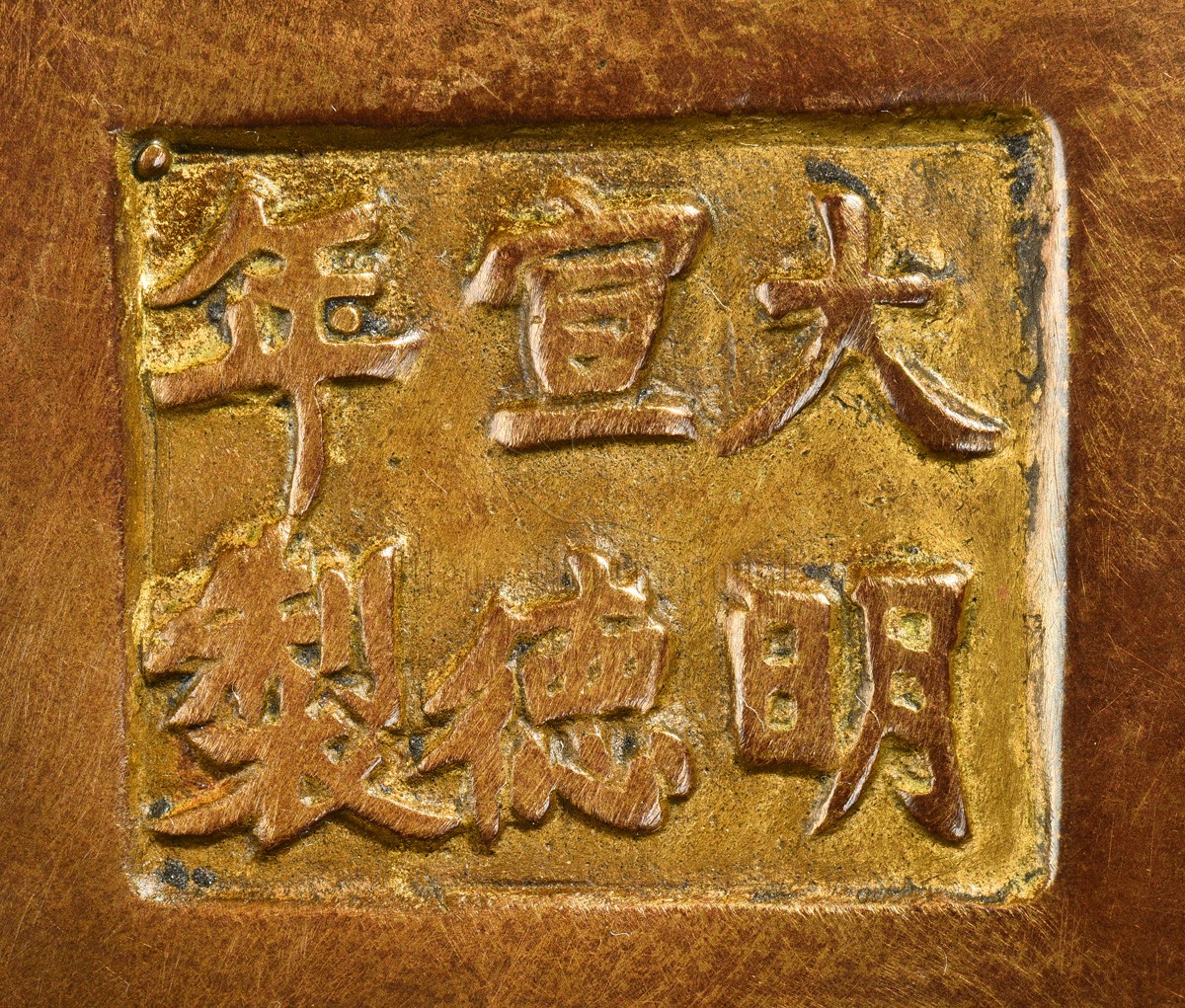
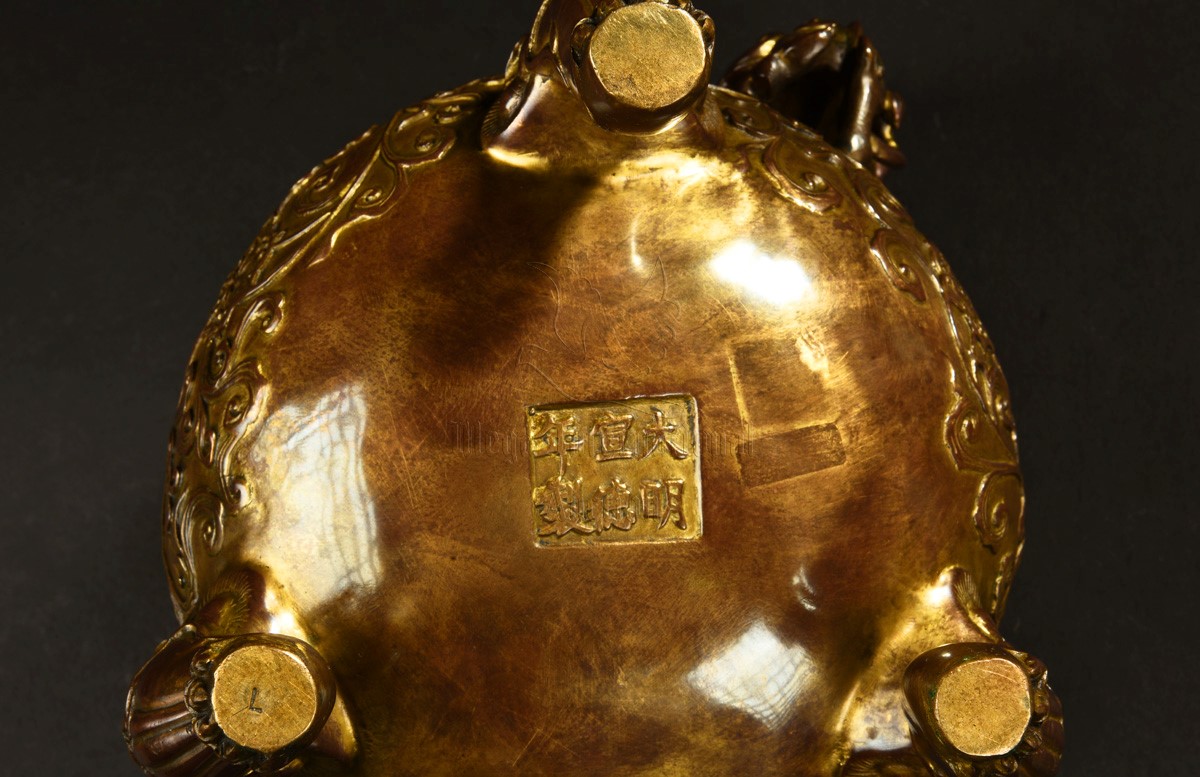
D. The bottom center inscribed with six characters “Da Ming Xuan De Nian Zhi” reign mark, with smaller and lighter than usual size, but inscribed with Kaishu style. Although it may not look as exquisite as Shen Du’s Kaishu, this particular font style is called Suo Ge Ti. As per Mr. Zhang Guangyuan, Ming Dynasty censer’s marks includes not only Shen Du’s Kaishu font, but also includes Ouyang Xun’s Kaishu, Zhuanshu, and other fonts, although Shen Du’s Kaishu font is the most common, and later on copied the most. Another possible explanation was the mark inscribed by Imperial court or officials, and since it was not named, it was hard to identify. The Ming Dynasty censers that have marks written in Suo Ge Ti font were extremely rate, since they were dated between Xuande and Jiajing reign period, similar to the Blank Period of Ming Dynasty porcelains. For example, during the Ming and Qing Dynasty Period Bronze Censer Exhibition in Tianjing Museum on July 2015, of the three hundred plus bronze censers, only a few has the marks inscribed in Suo Ge Ti font, and were dated Mid Ming Dynasty period.
Taipei National Palace Museum’s gilt bronze lion censer (Golden Ni Censer)’s inscription mark was also six characters, small size, and lightly inscribed. According to Mr. Zhang Guangyuan, the six characters have slightly differing depth and some carving marks, showing that it was definitely not copied, as then the inscription would be flat, not uneven. He also mentioned that the font was done by one calligrapher. This censer’s mark, when felt by hand, has uneven fonts, but smooth and not sharp, showing the age patina, and just like the censer in Taiwan National Palace Museum, it was not copied. The marks have slight difference, but both are not Shen Du’s font, showing its rare origins.
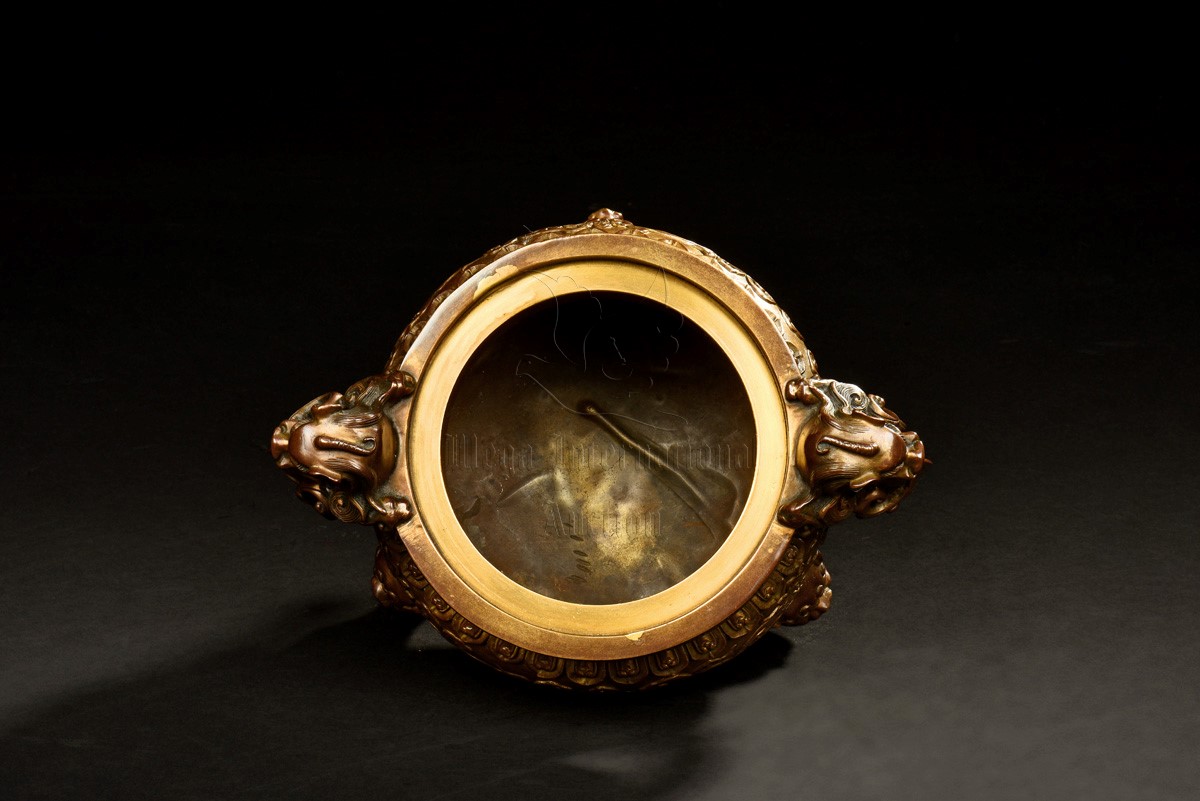
E. This censer’s cover fits tightly to the censer’s rim, the inside hollow with a small hole at each of the foot, in the same design as the censer from Taipei National Palace Museum. However, this censer’s interior was also gilt in full, although covered by the layer of patina, while the censer from Taipei’s National Palace Museum was not gilt on the inside (According to Mr. Zhang Guangyuan), and this is the main difference between the two censers. This censer was gilt on both inside and outside, and it must’ve been an Imperial Court censer to warrant such quality. Comparing the interior of the two censers, this censer looks golden with patina, while Taipei National Palace Museum censor already has green oxidation marks.
The inside of the censer does not have late Ming Dynasty censer’s incised patterns or marks, similar to the censer from Taipei National Palace Museum, and as such it is at minimum a Mid Ming Dynasty period Imperial censer. This rare completely gilt censer featured the best craftsmanship from Ming Dynasty period, is a definitive national treasure.
F. On the bottom of the censer next to the mark, there are two rectangular patch marks of different sizes, the larger one is of square form, the smaller one is of rectangular form, measuring approximately two centimeters. These patch marks were the result of original bronze fill marks. Refining bronze ware, especially high quality ones, may lose some bronze during the molding process, and thus needs the patch to fill additional bronze. This is a sign of expert craftsmanship. The two rectangular patch marks (Taipei National Palace Museum’s censer does not have these marks) feels incredibly smooth, the patched bronze had same quality as the original bronze, mixed in naturally, the interior only raised slightly and without damage, indicating the mark was probably left during the original creation. And since this was an Imperial censer, it was likely done by the master craftsmen from the Imperial Court, as the patchwork was done expertly, something that is hard to replicate. After the demise of Ming Dynasty period (1644 AD), the master craftsmen all left and scattered, losing the technique in the process. No Qing Dynasty or later censers were cast with such technique.
Even during Ming Dynasty period, there were not many bronze ware that were cast with such technique. Besides the Xuande censers, some gilt bronze Bodhisattva statues also utilize this technique, and experts theorize that the technique may involve welding techniques as well, since welding techniques were already commonplace in Ming Dynasty period, utilized on many bronze cast items during Jingtai period. The improvement in welding techniques helped jump start Ming Dynasty’s metallurgical development, especially evident on the welding of artworks, not only they were strong, but you could not see broken wires, dust, or welding marks. In the golden courts built during early Ming Dynasty period (year 1416 AD), many bronze parts were welded together, the technique far surpasses Song and Yuan Dynasty period. Mixed with casting technique, the bronze artworks look better and stronger. Theses rectangular patches showcased the Ming Dynasty period’s superior metallurgy process, including casting and welding, and it is hard to copy even today. The two patches on this censer are not imperfections, but certifies the censer to be an authentic and high quality Ming Dynasty censer, a piece of history that can be considered as a national treasure.
G. The Ming Dynasty censers were incredibly famous, as their craftsmanship and materials far exceed other metal works such as archaic bronze, and even today, the imitation Ming censers cannot exceed the original’s quality. The overall quality of Ming Dynasty censers exceeds Qing Dynasty censers (Except Imperial Qianlong censers), but not all Ming Dynasty censers were true gilt bronze. To qualify, the bronze must be reforged over eight times (At minimum it takes six forges to qualify a censer as Xuande censer), at that point, the zinc, tin, and other low melting point metals were dissipating, atoms accelerated impact bounces between bronze minerals, and the colors after forge is of vibrant rose color, similar to the trending European 18k rose gold. Only this quality can the censer be long lasting under the years of use, including incense burns, drops, corrosion, and other damage, allowing it to be used for generations. Thus, the rose gold censers from Ming Dynasty period are the best antique of the period, far exceeding the bronze Buddha figures, bronze vases, bronze plates, and other bronze ware, as the superb craftsmanship put the censers on a completely different level.
Xuande censers were only researched thoroughly in the last thirty years, similar to Yuan Dynasty blue and white porcelain, caught the eyes of collectors only recently. For additional information on Ming Xuande censers, please refer to Mega International Auction June 17th, 2017 auction catalog, there’s an article on the elephant mask gilt bronze Ming Dynasty censer in detail.
This censer has rim diameter of 14.8 cm, ear-to-ear length of 23 cm, height of 27.5 cm, and weighs 4812 grams. The censer in Taipei National Palace Museum has height of 29.7 cm, rim diameter of 15.8 cm, and weighs 4310 grams. The size of the latter is larger than the former, yet weighs slightly less. On both censers where the gilt falls off slightly, shows deep rose color tone instead of yellow bronze. And on some other small areas shows reddish-bronze and definitely not yellow bronze, just like Mr. Zhang Guangyuan said, “Part of the censer’s body shows dark black-brown color tone due to oxidation, reveals reddish bronze on the interior”. In previous years, there were many uncertainties of Ming Dynasty censer’s interior bronze, but only in 2018, there was consensus that the best Ming Dynasty censers must have reddish-bronze interior. If the interior bronze is yellow bronze, it means it was not reforged enough, and likely weighs less and dated after mid-Qing Dynasty period.
Rose gold bronze censers are the epitome of bronze censers, as they require a very large amount of minerals and long period of forge time. Even in Ming Dynasty period, Xuande censers were costly and expensive, and the rose gold bronze censers’ price goes up rapidly based on the weight, usually every 500 grams the price jumps to a new category. For example, a censer weighs 1000 grams and a censer weighs 2000 grams, the price is not just simply doubled, but usually five to ten times instead, as large quality Ming Dynasty censers are incredibly rare, making it a hot item in the world antique market. As time goes on, the value will only increase.
This censer, along with the censer from Taiwan National Palace Museum, not only have interior bronze in red, but also weighs heavier than typical censers. For most authentic yellow bronze censers and rose gold censers, simply weigh it and you’ll feel the noticeable difference. However, not all heavy censers are rose gold.
For the cense with this dimension but weighs 4812 grams, it is a much higher quality censer than most censers of similar size from Ming and Qing Dynasty periods, and it’s even better than the censer from Taiwan National Palace Museum. The censer is only slightly smaller, yet weighs over five hundred grams more, meaning it must’ve been reforged twelve times, much better than the usual six to eight times, making it one of the best Xuande censers. Based on known research and speculation, the censer from Taiwan National Palace Museum was probably reforged eight times, as only the best censers will be gilt on the exterior. Thus, gilt Ni censers from Ming Dynasty period typically reforged a minimum of eight times, and if used by Imperial court, it must be reforged twelve times, as it was reserved for the Emperor.
The heavy censer is hard to lift with just one hand, and even with two hands, it feels sturdy, heavy, and dense. The bronze quality cannot be mimicked easily, the lead or red copper cast bronze feel and look completely different from the high quality rose gold bronze, something that no other lower quality material can copy.
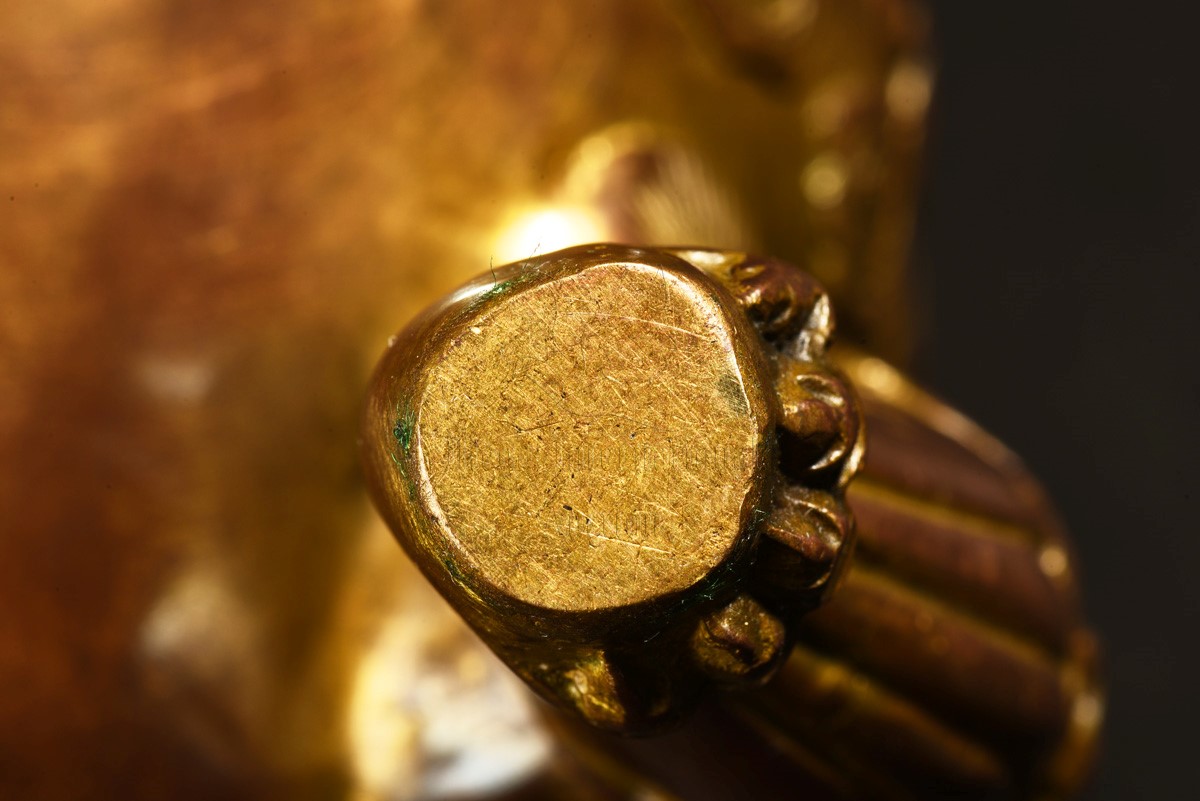
On the bottom of this tripod censer, after wiping off some dust, it shows slight age related wear, but retains heavy gilt, because the bottom of the censer was affected by oxidation less. The three feet of the censer stands firmly, study and balanced, it is very hard to move it or flip it by pushing.
H. In Norbulingka Palace of Lhasa, Tibet, hangs a large and significant Kesi Thangka, a gift from Ming Emeperor Xuande on Xuande year nine (1434 AD). On the top left corner of the Thangka, there appears to be a tripod Suan Ni censer, with only one horn. Starting from February 2018, this rare Thangka, along with other significant antiques, will be on exhibition in Beijing Capital Museum until July. Comparing with the museum’s high quality photography of the item, the Suan Ni censer’s body is fully golden, the exact same as the mandorla of the Bodhisattva, thus it should be a fully gilt Imperial court gift, showing that in Xuande years they’ve been making Suan Ni censers. This Thangka is a reflection of religiousness of the time, with impeccable details, showing that the censer is incredibly important in Imperial Court.
In the Ming Dynasty Xuande Censer Catalog, this censer is considered exceptionally large, as most of the Ming Xuande censers were smaller in size. Due to the high material cost of rose gold censer, most of them weighs around 2000 grams, and the censers that weigh over 3500 grams are especially rare, as the collectors aren’t willing to sell these treasures. Due to the amount of reforge required for rose gold censer, the quality is considerably higher than bronze wares of the same period. For example, a Ming Dynasty period bronze vase contains about 12%-15% of zinc, but the rose gold censer would contain less than 5%, making its density, colors, patina, weight, and durability much better. The Ming Xuande Dynasty censers were often called “The Gold Among Bronze”. After Qing Daoguang Dynasty period, the censers usually contain over 22% zinc, thus appear to be yellowish color tone, the lowered quality cannot compare to the earlier Qing Dynasty period censers, and especially incomparable to the Ming Xuande censers. The bronze censer surface may be able to be copied, but not the quality of bronze. The Ming Dynasty’s superb craftsmen crafted the best bronze censers because their devotion, spirit, and techniques, passed down from generations of knowledge, thus leading to the magnificent rose gold censers.
This censer is much larger and heavier than typical Xuande censer, gilt on both exterior and interior, with impeccable craftsmanship on the carvings, and Imperial Court pedigree. This is a truly one of a kind censer, worth the attention of every collector.
I. This censer was preserved very well, with no cracks or chips, and even under microscope, there’s only very few tiny dings, retaining almost perfect condition. There’s less than ten authentic Ming Dynasty Suan Ni censers of this size and weight, making it highly desirable in the antique market.
In the antique market, all high quality Ming Xuande Dynasty censers are rare and highly sought after, yet the actual available censers are far and few in between, much lower quantity than porcelains, bronze Buddha statues, and paintings. In recent years, even though the Xuande censers have been rising in price, but due to only recent rise in popularity, the price is still far behind porcelains and paintings. However, the slow start doesn’t mean it won’t appreciate faster in the future. During the Ming and Qing Dynasty period, a high quality bronze censer was often priced higher than high quality porcelain, and was one of the top treasures of a study room, and was highly sought after even during its era. Right now, the Ming Xuande Dynasty censers are still valued below its actual value, and one day, these censers will appreciate to its correct market value.
In the recent years with the development of computer design and 3D design, many antique bronze censers were copied in style, including the Suan Ni censer, but the fakes are very obvious to the knowledgeable collectors. The style, bronze quality, color tone, design, lines, and patina all show visible difference, and can be easily identified.
J. This spectacular gilt bronze censer is now available for auction. Its design, color, mark, quality, and craftsmanship are all top notch, and it is the best Ming Xuande Dynasty censer to be available for auction in the past fifty years. This Xuande Imperial Court censer more than qualifies to be considered as a national treasure, with easily distinguishable features and qualities.
Height: 10 7/8 in (27.5 cm) Ear-to-Ear Length: 9 1/8 in (23.0 cm) Rim Diameter: 5 7/8 in (14.8 cm) Weight: 4812.0g
Estimated Price:
$1500000 - $2000000
Ming Dynasty period.
Provenance:Mr. Osborne, a famed Asian antique collector, operated an antique store within Pacific Asia Museum at Pasadena, and he was also the consultant for the museum. He passed away more than ten years ago. The current owner of the gilt bronze censer is an artist, painter, and philosopher, specializing in collecting Xuande period censers. He immigrated to United States from Taiwan as First Preference EB-1 with Extraordinary Ability. The censer has been appraised and identified by multiple specialists, all agree that this gilt bronze censer was dated before Mid Ming Dynasty period, with supporting evidence listed in the accompanying document of the censer on the catalog.
Reference: Ming Xuande Dynasty Gilt Bronze Censer, cover page and article, Taipei National Palace Museum Magazine, issue 85, April 1990
The gilt bronze cast censer is of bulbous form, stands on three beast legs extending from beast masks, body depicts scrolling flowers and vines beneath lappet band patterns, two vivid mythical beast handles mounted on the sides, with openwork carved domed lid on top, mounted with a recumbent mythical beast, bottom bears six character XUANDE reign mark.
詠大明金猊爐
1. 一代江山傳奇物, 千古絕唱宣德爐,
堂堂四千八百克,威重如山鎮明府。
2. 雕工造極光藝道,幽古神韻耐百讀,
金猊燦燦辟邪偽,真氣煌煌護人主。
3. 烈火熊熊十二鍊,華潤瑰麗越凡俗,
通體已成玫瑰金,不與世間爭有無。
4. 滄桑歷盡國事非,一身風骨如當初,
珠璣散空可再起,國寶錯失緣難復。
5. 天才只為文明生,一旦乘龍驚四處,
一爐淨香射斗牛,萬峰朝盼新日出。
6. 天才只為正義生,人間有難勇支助,
一爐淨香沖天際,宇宙為心萬神扶。
(引自洛杉磯子焜長詩)
事隔近三十年,而今勝緣降臨,本爐於玆赫赫登場,可謂橫空出世而先後輝映矣!本爐乃私人收藏家在1980年代中,高價購自美國白人Osbon收藏家手中。Osbon先生是在1950年代買入的,他精於銅爐鑑賞,研究多年而甚有心得!本爐也,在明代嘉靖名士祝枝山傳摹的【宣德彛器圖譜】中,名為【金猊爐】,本爐無論從型制、膚色、紋飾、鎏金、内膛及銅質,皆基本與台北故宮的相同,只有尺寸重量與款識,略有些微出入,雖整體内外相似度達百分之八、九十,但仍存有不同點而獨具風華的特色,此所以稀貴也!
以下關於本爐將作進一步論述:
A. 【金猊爐】即鎏金的狻猊宣德爐,明代人稱狻猊,形似獅子,性好煙火,故多坐於香爐蓋上,是中國自唐代以來的神獸。唐代銅境的狻猊造形,有的頭上長角,增其威猛,狻猊有雙角和獨角之別,而獨角狻猊是結合了獅子、辟邪和麒麟于一身,成爲中國的守護神獸!本爐是獨角狻猊,與台北故宮的一樣,安坐爐蓋上,獅頭回顧,舌翹口張,雙目圓凸,炯炯有神。左右前足趴伸,足作四爪,左後足舉起而以爪搔下巴,右後足則隱藏而只露出三足。獅頭髮毛分成五股,垂貼頸上,頭頂中央長出一根彎勾形的直紋枝角,雙耳向左右平伸,脖子作橫式曡弧紋,獅身之背脊關節凸顯,露出十一節,獅尾之毛,理成七股,左右兩股較短而收卷,中間五股並排而往上翹起,口與腮形又像龍嘴,全身體態靈動壯美!
爐身以雙螭分左右攀立於腹部及口沿上,作爲爐耳,螭頭則反顧背部,頭頂有一彎鈎形長角,髮毛理成四股,分左右垂于前足上,兩耳後豎,鼻形與獅鼻同,嘴則閉合,下巴有鬚作兩小股而分開兩邊,螭身扁圓形,前二足之爪分別攀附于爐口上,後二足之爪則攀附于爐腹上,全形優美生動,以上所述細節(包括所指數目),本爐與台北故宮的,完全吻合!
再者,三隻爐足表現得極爲遒勁有力!足部之上端作獅頭形,威風凜凜,頂上無角,髮分四股,左右迴旋,雙耳後展,獅口賁張,齒腮近似龍嘴,腿有五條凸起直紋,下連五爪至足根,足底接近圓形,腿部強健而不臃腫,虎虎生風!
又爐蓋表面為浮雕四朵蓮花紋, 安置於前後左右四方,有三朵作十枚花瓣, 背面一朵卻有十二枚花瓣,四朵蓮花之間,穿插波浪枝莖,有如巻雲迴繞,亦如仙衣之飄帶,分佈於花莖之間,其鏤空處,香煙可繚繞而出矣!
還有爐身口沿飾雲雷紋一道極精緻,口沿下,束頸無紋,頸下腹上雕飾三十三片蓮瓣紋,腹面則浮雕纏枝蓮花紋,其蓮花為六朵,纏枝蓮紋乃明代藝風,繁褥精美,以上所述細節包括所有數目,本爐均與台北故宮的,一一吻合!
B. 本爐氣勢非凡,巧奪天工而情韻迴盪,宣爐中的極品,當之無愧!明代宣爐多做素面,而此金猊爐卻精雕細刻,逸群絕倫,加之通體鎏金,其內蘊精光,而英華發外,可謂在明清兩代銅爐中,宛若眾星拱月,萬目所歸也!本爐黃金成色經測定約為22k,歷經古人長期斷斷續續的焚香使用,留下了煙塵已深入肌裡,形成一層氧化膜。前代人又經過長期焚供後的清潔或濯洗,故鎏金有少許部分已逐漸剝蝕,手容易撫摸擦拭到的地方,則包漿舒潤亮麗,死角處則有灰漬顏色,整體金水濃淡及包漿的自然分佈,質感與時間過渡極為自然,符合數百年滄桑的氧化特徵,這是造假者無法模仿到位的!也是現代人使用電腦3D技術仿製無法辦到的!
C. 此大明金猊爐皮色之美,乍觀之,泌人心脾,久視之,如入勝境,徘徊無已!
1、所謂鎏金厚足且黃中泛紅,此明代標準色也!
2、所謂大氣磅礴且圓融溫馨,此明爐渾厚優雅之特徵也!
3、所謂歷史積澱卻清潤如液,此包漿瑩厚之故也!
4、所謂金水剝蝕卻風骨畢露,此宣銅真跡,玫瑰金也!
5、所謂曲線流暢而質精色麗,此明爐之國色天香也!
6、所謂雄健瑰放而絢爛四溢,此明爐之英豪傳奇也!
7、所謂剛柔並濟又幽古奧遠,此明爐獨有神韻也!
8、所謂肌膚細膩又穩重如山,此明爐一代風華也!
本爐之美,有如上述,歷代傳承至今,其皮色、包漿、形韻皆在在顯示明代稀世寶物之超卓雋美,是真是偽之辨,已判若鴻溝矣!本爐整體皮色與台北故宮的極相似,後者除展示期外,多半密藏于箱中,故看起來略新,本爐包漿則較後者腴潤,但鎏金部分,兩者皆有微小剝落,本爐則略多于後者,這可能是古人在數百年的傳承中,有過長期或不定期的焚香使用與擦拭,及長久曝露于大氣中所致!也因此,整體之包漿韻味比後者腴厚而潤亮也!細觀本爐之皮色尚未經機器抛光或用強烈的擦銅劑打磨。歐美人士收藏金銅藝術品,喜歡從事清理及抛光來展現金貴的美麗光澤,在蘇富比與佳士德拍賣的鎏金銅件中,經常可見到品相乾淨如新的古物,與華人審美觀念略異!
本爐在容易撫摸到的部位,以及沒有花紋而較平整的地方,包括内縮的頸圈、獅鈕(狻猊)的背後、爐口、底面與螭身等等,皆顯得特別瑩潤。歷經好幾代滄桑的養護,本爐已出現極其罕見的玻璃光蠟皮,它融合了數百年的氧化灰漬,整體神韻高古而莊嚴瑰麗,大明皇家貴氣,籠罩全屋,不可擋也!大明吉金燿采,縱對看終日而淪肌浹髓,又不可擋矣!
D. 本爐底面中央之銘文為【大明宣德年製】六字款,字體較一般的款識小,刻字也較淺,字跡雖有楷書筆意,但沒有沈度的楷書精良,字風俊逸,別具一格,此乃【縮格体】也!據張光遠先生稱:明代的爐款,並非沈度字體可獨攬,另有歐陽詢的楷書、一般的篆書及其他,不一而足!只不過沈度的較普遍,以致後世仿製的也最多!另外也有一種可能,不排除有皇家或大臣的親筆在内,因未署名,較難認定也!
明代縮格体款識之銅爐,目前文博界認爲年代處於宣德至嘉靖之間,類似明代瓷器的空白期,數量稀少!如2015年7月天津博物館舉辦大型的明清銅爐特展,共計三百餘件,其中僅有特少數的縮格体銅爐,年代定在明中期!
台北故宮的鎏金獅爐(金猊爐)銘文,同樣是六字款,字跡不大,刻字不深,據張光遠先生稱:其六字陽文筆劃略有高低不平及刻損現象,而銘文底面也有剔削未平痕跡,故銘文是通過直接浮雕腊模所鑄成的!絕非字模印製,若字模印製,銘文底面較平坦,無剔削不平現象。又稱:字體乃出自另一書家之手(不可考)也!
本爐之款識,用手撫摸,字略有高低,卻甚滑潤而毫無扎手或澀刺之感,顯示包漿厚實,且與台北故宮的情況一樣,均屬直接浮雕蠟模而後鑄成的!兩者字跡筆畫略有差別,但相差不大,兩者亦均非一般流傳之沈度楷書也!由於縮格体款識不多見於明爐中,應屬稀罕之品!其珍貴可知矣!
E. 本爐寳蓋與爐口緊密相貼,嚴絲合縫,周正規整,工細法精。寳蓋内,獅鈕中空,内膛三足則各有一孔洞,與台北故宮的相同,但本爐寳蓋内面以及整個内膛,皆全部鎏金,惟被一層密實貼骨的煙漬所掩蓋,不停地強力擦落煙漬則金水煥然而出矣!然台北故宮的獅爐其寳蓋内面與内膛,皆未鎏金(張光遠述),此乃兩者大不同處也!本爐通身内外皆得金水,極度珠光寶氣,實不同凡響!可見其不惜工本而隆重鑄就,若非皇家特製,焉得如此大費周章?再者,本爐内膛因金水厚實,從不生銹,而台北故宮的,卻早已銅綠斑斑矣!此又為兩者之不同處也!
本爐内膛無晚明之放射性跳刀痕或旋削紋的特徵,與台北故宮的情況一樣,年代如前所斷,至少是明中期或之前的官造爐無疑!今揆之於明清兩代冶金工藝,其通體内外皆鎏金的精品爐,真可遇不可求矣!此非國之重器而何?
F. 本爐底面的款識右邊,有一大一小兩個方格補丁,大的是正方形,小的是長方形,並排一起,長度約近兩公分。此方格補丁,乃原始補鑄痕跡!銅質因特別精錬,在灌模流淌時,偶爾會出現漏銅現象,故需補鑄。這種補鑄並非缺失,正説明其工藝精湛,質量不凡的表現!本爐具有兩個方格補丁(台北故宮的沒有),手指撫之極爲平順瑩潤而毫無疙瘩,補鑄之銅質與爐胎完全一致,渾然天成而整體融合。内膛底部有一道微微凸起之痕跡,卻毫無傷損,這可能是灌模補鑄時所留下的。又本爐既為官造爐,故原始補丁亦即明宮御用監(相當於清宮造辦處)的原作坊所補鑄的,其質量之高及修飾之美,絕非後代所能做到!自明亡(1644年)後,宮廷藝匠四散,罹此國破家亡之際,迭遭生死離別之痛!入清(17世紀下半葉)後,清廷造辦處雖廣募人才,卻獨缺此術,故整個清代之銅爐看不到方格補丁的風格,明朝鑄爐之一代奇技,惜至清初時,便已失傳,迄今長達近四百年,此乃文博界公認的事實!江山板盪,天才凋零,今日能目睹本爐,令人感慨思念而珍惜不已!明代人之冶鑄風格,借此可以紀錄而長留後世,何幸如之!
明代銅器留有方格補丁的,目前所知不多,除宣爐外,尚有金銅佛等,方格補丁有專家推測可能配合特殊的焊接技術完成,因明代早期焊接技術已運用成熟,至景泰年間,更大量施展于銅件的成品上,尉為奇觀。焊接技術的提昇,使明代冶金工藝有突破性的進展!其在藝術品的組合銜接上,不僅牢固,且看不到斷絲、殘渣或接痕。如早在1416年明早期所建的金殿中,許多銅件多用焊接組合而成,技術遠勝宋元兩代!除焊接外,尚有鑄接,有時交相使用,如何令藝術品更牢更美,明人真的是運用之妙,存乎一心矣!
這種方格補丁在銅器上的記號,顯示了明代以前冶金(包括焊鑄)的高超技藝,即使至今,古物造假者,仍皆無法仿製。本爐兩處補丁,不僅不是缺陷,反而是明風的不朽傑作,標誌著大師藝匠的苦心孤詣與飛軒絕跡,更成爲宣爐斷代的標準器!自古國之重器,天涯難覓,亦惟有雄才偉士,亦惟有俊彥奇葩,足以承擔以延續文化香火也!
千山爭盼祥雲到
萬朵繚繞在奇峰
天道有靈酬善功
寳爐颯颯傲東風
宣德爐是從最近三十年來,才慢慢逐漸被研究清楚,很像元青花,也是近世在宣爐熱之前,才風起雲湧,受到萬人矚目的!有關宣德爐的種種鑑賞知識,請參考本公司2017年6月17日,拍賣明代象首耳爐時,有近萬字長篇的精細論述,喜好宣爐者,必讀也,在此不必重覆!(Mega International Auction)
本爐之口徑14.8公分,耳距23公分,高27.5公分,重量4812克,台北故宮的鎏金獅爐(金猊爐)則高29.7公分,口徑15.8公分,重量4310克,尺寸與重量兩者略爲不同!後者體積稍大于前者,但重量較輕!兩者同時在金水剝落處,可明顯看出隱伏的深玫瑰色,而非黃銅顔色!其他還有小地方,隨著時間氧化的自然過渡,金水剝蝕後的包漿覆蓋,瑩潤中透露出古銅赤色的痕跡,其銅胎絕非黃銅,而是赤色的銅合金,正如張光遠所言:【爐身局部因氧化而呈現黑褐色,露出的銅胎,可見泛紅的銅色】。明代宣爐銅胎在多年前尚不太定性,直到最近(2018年)文博界才大多認定,明代精品爐,銅胎必赤!!銅胎若是黃銅,則表示精錬度的質量還不高,且比重較輕!黃銅香爐大多出自清中期之後也!
玫瑰金爐乃銅器之頂峰,也是有明一代冶金工藝的代表作,它要耗費許多的鑛料,以及長時間的工程,始克畢就!在明代時,宣爐已經很貴,且玫瑰金爐是斤斤計較的,通常每增加500克(一斤),即跳上一個級數,譬如同等級爐1000克與2000克之別,不是乘以兩倍價格,經常是五倍十倍在起跳,因爲明代較重較大的上等好爐早已成爲珍稀之品,全世界偌多收藏家爭相收購、追捧,僧多粥少之下,自然未來行情,欣欣可期也!
本爐與台北故宮的,不僅銅胎均為赤色,且比重也比一般的更壓手!一般到代的黃銅爐跟玫瑰金爐,只要上手一掂,立刻分明,假不了的,玫瑰金永遠就是玫瑰金,縱拿其他銅佛、銅瓶也難以相比!再説壓手感有三、六、九等不同,不是所有壓手的銅爐,就是玫瑰金爐,勿入誤區!
若以本爐之尺寸、重量卻高達4812克,衡之於明清兩代同樣大小的銅爐,可謂推倒一時豪傑,罕有其匹!即使台北故宮的獅爐,亦膛乎其後矣!今以明人的鑄爐法而論,本爐比後者略小,然重量卻多出五百克,此非達十二錬不為功,而只有十二錬的特級凝重感和壓手感,方足以獨領風騷,藝驚士林!其他任何宣爐,皆無可逾越,身份不同,價便懸殊。明爐之重量即分量,未有重量平凡,而能擠進玫瑰金之行列也!同樣,未有凡人之氣質思想,而能升入神聖之光華世界也!
經研究推斷,台北故宮的獅爐,已臻乎八煉的境界,明代的官造鎏金爐一般都不低於八煉,亦即八煉以上的玫瑰金,才鄭重地飾以鎏金,雖非絕對,然亦十不離八九!故明代的金猊爐至少八煉以上,如皇家專用則必達十二煉,十二煉之極品,帝王自享,不贈與外人也!
本爐單手難擧,即使雙手端捧,亦頓感吃力,壓手感特強,有一股往下的強勁拉力,不易支撐,覺得極為渾厚又凝重!然銅質不可作僞,加鉛鑄造或用紅銅灌鑄,離玫瑰金層級甚遙矣!玫瑰金爐必重必美,必精必潤,必貴必稀,非其他銅爐可企及也!銅中之金,決非虛言!
再者,本爐三足的底部,經擦除塵漬後,雖有磨損,金水仍厚,並未剝落,蓋因足底受空氣氧化影響較少,歷經數百年,雖有摩擦痕,猶金光燦燦,宛若當初!所謂【帝室宣爐,足踏黃金】,此之謂也!本爐三足赫然鼎立,用手推之,不易動且不易倒,穩如泰山,遠望之,鋒發韻流而氣宇軒昂,近觀之,夭矯不羣而威風凜凜,大明金猊爐之美,言不盡矣!其匠心之獨運,淋漓盡致且絲絲入扣,又讓人思不盡矣!
H. 目前藏於拉薩羅布林卡的鎮寺之寶- 大慈法王緙絲唐卡,乃宣德九年,皇帝賞賜給西藏大慈法王的珍寶。在唐卡的左上方,赫然出現一座三足狻猊爐,而此狻猊並非雙角,應是獨角狻猊。2018年2月份開始,此件珍稀唐卡伴隨其他重要文物,將在北京首都博物館展覽至7月份,經博物館清晰拍攝原物比對,此狻猊爐全身是金黃色,與唐卡中大慈法王頭部聖光的顏色一致,故應屬通體鎏金的隆重御賜品,而非黃銅製件,證明宣德年間即有金猊爐之製作,可見金猊爐自宣德以降,已源遠流長矣!此件唐卡作為宗教意義上的圖像表現,是細膩而完全寫實的,相當於那個時代的照片一樣,當時金猊爐在皇家心目中的分量,誠非比尋常矣!
又本爐在明代宣德爐譜中,屬於中大型之巨製,明代各朝宣德爐之作,以小型居多。因玫瑰金爐成本太昂貴,一般都在兩千克上下,超過三千五百克以上,存世量已甚稀少,早為收藏家納入囊中,不隨便也不輕易讓出!!玫瑰金爐因為冶煉次數較多,淘汰雜質及氧化物也較多,故質量上與銅瓶、銅盤、銅佛等等,早已拉開了一大段距離!如銅瓶(明代)的含鋅值約百分之12至15之間,而明代玫瑰金爐必在百分之五以下,不可同日而語,銅胎之精密度既有差異,所表現出來的珠光寶色、凝重感、壓手感、細膩度、耐用度等,則完全不同矣!明代宣德爐號稱銅中之金,是具備充足理由的!與其他銅製品不可等量齊觀!銅中之金、炳耀古今,絕非虛言也!清代嘉慶道光以後,爐胎含鋅量多超過了百分之二十二以上,故呈現黃銅色澤,不僅不能與清三代相頡頏,較之明代,更不能相提並論矣!銅爐表面可造假,銅質(銅胎)不能作僞,明代銅爐具有宣德以來前無古人之傳統精煉的大匠精神,故能誕生熠熠不朽的璀璨紅金(玫瑰金爐),可以說,那正是明朝一代又一代偉大的技藝接棒,可以說,那正是明朝一代又一代偉大的香火傳遞! 銅中之金,豈偶然也!如同每個人的靈魂,在大地上,湏経千百年的淬鍊,始能從物質界中破殼而出,綻放人性的光輝而得到昇華,故認知要深睿,命運不以一世因果作論斷,眼界必宏闊,進化不以塵寰百年為局限一樣,一旦悟道,則不再永遠于大地穿梭爬行,必向宇宙高處的真實璀璨世界升進!!浩瀚無涯涘矣!
換骨湏得真仙丹 脫胎必從質量鍊
銷盡凡渣無塵點 留下紅金驚世間
金猊爐 香正熱 千流萬派我獨艷
金猊爐 辟邪惡 浩氣蓬勃蕩雲天
I. 本爐保存相當完善,毫無裂痕及傷損,僅有在放大鏡下,可以看見的少許小磕碰,品相極爲完美,真正明代尺寸如此碩大而通體鎏金的金猊爐,全世界擁有的,目前不會超過十件,金猊爐在收藏界奉若神尊,是罕見而極其難得的稀世國寶!
金猊爐除罕見之外,即使明代的所有高檔爐,也已成爲當今最稀少的熱烈收藏品項目,且數量遠遠不及瓷器、銅佛及書畫各項的百分之一!近幾年,宣爐雖獲追捧,但價格亦遠遠落後于瓷器及書畫諸項,這是由於宣爐乃最近二十年才竄起,已成方興未艾的熱門古董,起步雖慢,並不表示可見的將來,不能領先群倫。明清數百年間,好銅爐經常價高于好瓷器,屬於文房之首的珍寶,古時已極爲考究而愛惜有加矣!明代宣爐價格目前偏低,必有朝一日,宣爐終將高步云衢,在世界上揚眉吐氣,此屈指可待也!
近十年由於電腦設計圖及3D技術提升,許多古代銅爐都遭仿製,包括金猊爐在内,但明眼人一看便知其造假!其神韻、銅質、皮色、古意、綫條及包漿,仍有明顯差距,難以模仿到位,當一般工藝品擺飾則可,當古董則詐矣!僞矣!不可不知也!
J. 今本爐隆重推出,論型制,論皮色,論款識,論質量,皆上上之選,宛若曠世奇才而神資並妙,亦如龍躍雲津而推群獨步!本爐之珠光寶氣,通體内外鎏金,富麗堂皇且貴氣逼人,可謂震鑠八方,冠絕一切矣!這是全世界五十年來,所有拍賣公司最高檔的明代宣德爐之一,百年難遇!本爐集真、精、新、奇、稀、美,六絕于一身,明宮至珍,妙絕時物,非稀世國寶而何?雖不必定為其為真宣(宣德年間所製),亦直追真宣之風骨矣!雖不必定其為真宣而疑似真宣,亦直追真宣之品貌矣!宣德之功,千古風華,舉世驚艷也!
Around thirty years after the article, this very similar Ming Xuande Dynasty National Treasure Exquisitely Carved Gilt Bronze Censer is appearing for the first time for the collectors worldwide. This censer was purchased by a private collector from the American collector Mr. Osbon during the 1980’s, who was a Chinese bronze ware expert, first obtained it during the 1950’s. This censer, according to Ming Jiajing Dynasty’s book “Xuande Bronze Vessels Catalog” by famous writer Zhu Zhishan, this censer is named “Golden Mythical Ni Lion Censer”, and this censer’s style, color, patterns, gilt, interior, and bronze type, all pretty much is the same as the censer in National Palace Museum, only the size, weight, and mark are slightly different. Although it is 80-90% similar, it also has unique traits, making it very valuable.
I will now describe the censer in detail below:
A. “Golden Mythical Ni Lion Censer”, or gilt bronze Suan Ni Xuande censer. During Ming Dynasty period, Xuan Ni is a mythical beast that looks like a lion, with ferocious temper, and thus it was usually resting on top of censer lids, and was one of the famed mythical beasts since the Tang Dynasty period. On the bronze mirrors of Tang Dynasty period, Xuan Ni’s has differing designs, some with single or double horns on the back of the head, making it even more mighty. Single horn Xuan Ni is a combination of lion, Pi Xiu, and Qi Lin, served as a Mythical Guardian Beast of China. This censer features a single horn Xuan Ni, the same as the one in National Palace Museum, seated on top of the lid cover, the head turned sideways, with bulging eyes and wide open mouth. The front legs each with four-claw paw, resting in front of the body. The left back leg raised to chin level as if it is scratching its itch, the right back leg hidden from the views. The mane hair separate into five strands, resting on its neck and back. A single horn extends from the center of its head, curves elegantly towards the back. Two ears leveled, the neck has layered ring patterns, the back shows eleven spinal segments, the tail separated into seven strands, the left and right two strands were short and curled, middle five strands raised upwards, the mouth and chin looked similar to a dragon’s mouth, and the entire body beautifully carved.
The censer’s body mounted with two Chilong on the left and right side, attached to the rim on top as censer ears, the Chilong’s head turned backwards, with a curled single horn on top of its head, the manes separated into four strands, covering left and right side of front paw, two ears curled back, the nose shaped similar to a lion’s nose, two front paws mounted on the rim, the back two legs mounted on the waist of the censer, beautifully carved. All the details above, including numbers, are identical to National Palace Museum’s censer.
In addition, the three censer legs look extremely sturdy and strong. The legs extends from lion masks, each without horns, the manes separates into four strands, curls to the sides, two ears hangs back, mouth wide open, the teeth and chin looks like dragon’s mouth, the extended legs each has five raised patterns, extends all the way to the bottom of foot, the foot’s bottom is almost rounded shape, showing the legs as strong and lean.
The censer’s surface relief carved with four scrolling lotus flower patterns, each located on the body with similar distance, three of the flowers have ten flower petals, while the remaining flower has twelve petals. Flower vines and petals intertwined between the flowers, shaped similar to stylized clouds and robe bands.
On the rim of the censer covered with scrolling yunlei pattern, no pattern on the waisted neck, and thirty-three scrolling lotus petal patterns on the shoulder. The belly relief carved with intertwined lotus flower patterns, with six flowers. These patterns were all very typical of the Ming Dynasty period, and all the details accounted above, including numbers, are the same as the censer in Taipei Palace Museum.
B. The grandeur censer was exquisitely crafted and was definitely one of the best among other Xuande period censers. Most Ming Xuande Dynasty censers have plain exterior design, but this gilt bronze Ni censer was meticulously carved, showing expert craftsmanship. The censer was gilt entirely, showing beautiful and aged shine on the interior and exterior, exceeding the quality of most Ming and Qing Dynasty censers. This censer’s gold was tested to be around 22k, and after usage through hundreds of years, the incense dust became part of the censer as a layer of oxidation. The years of washing and cleaning the censer has also caused slight loss of gilt. The easy to reach parts of the censer has a layer of beautiful age patina, and the hard to reach corners has slight greyish color tone, the entire gilt and patina spread evenly, showing natural oxidation of an antique with hundreds years of age, something that cannot be recreated with modern technology.
C. This Ming Xuande Dynasty golden Ni censer has beautiful exterior color tone, with the following traits:
a. The gilt was dense and heavy, with yellowish-red color tone, the standard color of Ming Dynasty censers.
b. The magnificent censer is grandeur and smooth at the same time, a trait of Ming Dynasty censer.
c. The long history of this censer has left the censer a layer of beautiful patina.
d. The areas with slight loss of gilt shows rose gold interior, the same as other Xuande censer of the same time period.
e. The exterior design of the censer has smooth and elegant lines.
The beauty of this censer, as described above, has been passed down for generations, its color, patina, and design all shows that it is a national treasure from Ming Dynasty period. The overall color is very similar to the censer in Taipei National Palace Museum, and the latter was usually kept in storage when not in exhibition, thus look slightly newer. This censer has more patina, but slight loss of gilt, showing that it was used and exposed to air more in the hundreds of years, thus leading to better patina. Looking closely to the color of the censer, there’s no machine marks or grinds. European and Americans prefer to have polished bronze artworks to show its beauty, and the gilt bronze wares sold by Sotheby’s and Christie’s look usually exceptionally new after the polish, differing wildly to Asian’s preferred look.
On the easy to reach areas of the censer, and areas without patterns, including waisted neck, back of the lion knob, the rim, bottom, and body of chilong, all appear to be exceptionally smooth. After generations, the censer has developed a rare layer of glass wax-like skin, combining hundreds years of oxidation and dust, showing the extravagance of Ming Dynasty Imperial.
D. The bottom center inscribed with six characters “Da Ming Xuan De Nian Zhi” reign mark, with smaller and lighter than usual size, but inscribed with Kaishu style. Although it may not look as exquisite as Shen Du’s Kaishu, this particular font style is called Suo Ge Ti. As per Mr. Zhang Guangyuan, Ming Dynasty censer’s marks includes not only Shen Du’s Kaishu font, but also includes Ouyang Xun’s Kaishu, Zhuanshu, and other fonts, although Shen Du’s Kaishu font is the most common, and later on copied the most. Another possible explanation was the mark inscribed by Imperial court or officials, and since it was not named, it was hard to identify. The Ming Dynasty censers that have marks written in Suo Ge Ti font were extremely rate, since they were dated between Xuande and Jiajing reign period, similar to the Blank Period of Ming Dynasty porcelains. For example, during the Ming and Qing Dynasty Period Bronze Censer Exhibition in Tianjing Museum on July 2015, of the three hundred plus bronze censers, only a few has the marks inscribed in Suo Ge Ti font, and were dated Mid Ming Dynasty period.
Taipei National Palace Museum’s gilt bronze lion censer (Golden Ni Censer)’s inscription mark was also six characters, small size, and lightly inscribed. According to Mr. Zhang Guangyuan, the six characters have slightly differing depth and some carving marks, showing that it was definitely not copied, as then the inscription would be flat, not uneven. He also mentioned that the font was done by one calligrapher. This censer’s mark, when felt by hand, has uneven fonts, but smooth and not sharp, showing the age patina, and just like the censer in Taiwan National Palace Museum, it was not copied. The marks have slight difference, but both are not Shen Du’s font, showing its rare origins.
E. This censer’s cover fits tightly to the censer’s rim, the inside hollow with a small hole at each of the foot, in the same design as the censer from Taipei National Palace Museum. However, this censer’s interior was also gilt in full, although covered by the layer of patina, while the censer from Taipei’s National Palace Museum was not gilt on the inside (According to Mr. Zhang Guangyuan), and this is the main difference between the two censers. This censer was gilt on both inside and outside, and it must’ve been an Imperial Court censer to warrant such quality. Comparing the interior of the two censers, this censer looks golden with patina, while Taipei National Palace Museum censor already has green oxidation marks.
The inside of the censer does not have late Ming Dynasty censer’s incised patterns or marks, similar to the censer from Taipei National Palace Museum, and as such it is at minimum a Mid Ming Dynasty period Imperial censer. This rare completely gilt censer featured the best craftsmanship from Ming Dynasty period, is a definitive national treasure.
F. On the bottom of the censer next to the mark, there are two rectangular patch marks of different sizes, the larger one is of square form, the smaller one is of rectangular form, measuring approximately two centimeters. These patch marks were the result of original bronze fill marks. Refining bronze ware, especially high quality ones, may lose some bronze during the molding process, and thus needs the patch to fill additional bronze. This is a sign of expert craftsmanship. The two rectangular patch marks (Taipei National Palace Museum’s censer does not have these marks) feels incredibly smooth, the patched bronze had same quality as the original bronze, mixed in naturally, the interior only raised slightly and without damage, indicating the mark was probably left during the original creation. And since this was an Imperial censer, it was likely done by the master craftsmen from the Imperial Court, as the patchwork was done expertly, something that is hard to replicate. After the demise of Ming Dynasty period (1644 AD), the master craftsmen all left and scattered, losing the technique in the process. No Qing Dynasty or later censers were cast with such technique.
Even during Ming Dynasty period, there were not many bronze ware that were cast with such technique. Besides the Xuande censers, some gilt bronze Bodhisattva statues also utilize this technique, and experts theorize that the technique may involve welding techniques as well, since welding techniques were already commonplace in Ming Dynasty period, utilized on many bronze cast items during Jingtai period. The improvement in welding techniques helped jump start Ming Dynasty’s metallurgical development, especially evident on the welding of artworks, not only they were strong, but you could not see broken wires, dust, or welding marks. In the golden courts built during early Ming Dynasty period (year 1416 AD), many bronze parts were welded together, the technique far surpasses Song and Yuan Dynasty period. Mixed with casting technique, the bronze artworks look better and stronger. Theses rectangular patches showcased the Ming Dynasty period’s superior metallurgy process, including casting and welding, and it is hard to copy even today. The two patches on this censer are not imperfections, but certifies the censer to be an authentic and high quality Ming Dynasty censer, a piece of history that can be considered as a national treasure.
G. The Ming Dynasty censers were incredibly famous, as their craftsmanship and materials far exceed other metal works such as archaic bronze, and even today, the imitation Ming censers cannot exceed the original’s quality. The overall quality of Ming Dynasty censers exceeds Qing Dynasty censers (Except Imperial Qianlong censers), but not all Ming Dynasty censers were true gilt bronze. To qualify, the bronze must be reforged over eight times (At minimum it takes six forges to qualify a censer as Xuande censer), at that point, the zinc, tin, and other low melting point metals were dissipating, atoms accelerated impact bounces between bronze minerals, and the colors after forge is of vibrant rose color, similar to the trending European 18k rose gold. Only this quality can the censer be long lasting under the years of use, including incense burns, drops, corrosion, and other damage, allowing it to be used for generations. Thus, the rose gold censers from Ming Dynasty period are the best antique of the period, far exceeding the bronze Buddha figures, bronze vases, bronze plates, and other bronze ware, as the superb craftsmanship put the censers on a completely different level.
Xuande censers were only researched thoroughly in the last thirty years, similar to Yuan Dynasty blue and white porcelain, caught the eyes of collectors only recently. For additional information on Ming Xuande censers, please refer to Mega International Auction June 17th, 2017 auction catalog, there’s an article on the elephant mask gilt bronze Ming Dynasty censer in detail.
This censer has rim diameter of 14.8 cm, ear-to-ear length of 23 cm, height of 27.5 cm, and weighs 4812 grams. The censer in Taipei National Palace Museum has height of 29.7 cm, rim diameter of 15.8 cm, and weighs 4310 grams. The size of the latter is larger than the former, yet weighs slightly less. On both censers where the gilt falls off slightly, shows deep rose color tone instead of yellow bronze. And on some other small areas shows reddish-bronze and definitely not yellow bronze, just like Mr. Zhang Guangyuan said, “Part of the censer’s body shows dark black-brown color tone due to oxidation, reveals reddish bronze on the interior”. In previous years, there were many uncertainties of Ming Dynasty censer’s interior bronze, but only in 2018, there was consensus that the best Ming Dynasty censers must have reddish-bronze interior. If the interior bronze is yellow bronze, it means it was not reforged enough, and likely weighs less and dated after mid-Qing Dynasty period.
Rose gold bronze censers are the epitome of bronze censers, as they require a very large amount of minerals and long period of forge time. Even in Ming Dynasty period, Xuande censers were costly and expensive, and the rose gold bronze censers’ price goes up rapidly based on the weight, usually every 500 grams the price jumps to a new category. For example, a censer weighs 1000 grams and a censer weighs 2000 grams, the price is not just simply doubled, but usually five to ten times instead, as large quality Ming Dynasty censers are incredibly rare, making it a hot item in the world antique market. As time goes on, the value will only increase.
This censer, along with the censer from Taiwan National Palace Museum, not only have interior bronze in red, but also weighs heavier than typical censers. For most authentic yellow bronze censers and rose gold censers, simply weigh it and you’ll feel the noticeable difference. However, not all heavy censers are rose gold.
For the cense with this dimension but weighs 4812 grams, it is a much higher quality censer than most censers of similar size from Ming and Qing Dynasty periods, and it’s even better than the censer from Taiwan National Palace Museum. The censer is only slightly smaller, yet weighs over five hundred grams more, meaning it must’ve been reforged twelve times, much better than the usual six to eight times, making it one of the best Xuande censers. Based on known research and speculation, the censer from Taiwan National Palace Museum was probably reforged eight times, as only the best censers will be gilt on the exterior. Thus, gilt Ni censers from Ming Dynasty period typically reforged a minimum of eight times, and if used by Imperial court, it must be reforged twelve times, as it was reserved for the Emperor.
The heavy censer is hard to lift with just one hand, and even with two hands, it feels sturdy, heavy, and dense. The bronze quality cannot be mimicked easily, the lead or red copper cast bronze feel and look completely different from the high quality rose gold bronze, something that no other lower quality material can copy.
On the bottom of this tripod censer, after wiping off some dust, it shows slight age related wear, but retains heavy gilt, because the bottom of the censer was affected by oxidation less. The three feet of the censer stands firmly, study and balanced, it is very hard to move it or flip it by pushing.
H. In Norbulingka Palace of Lhasa, Tibet, hangs a large and significant Kesi Thangka, a gift from Ming Emeperor Xuande on Xuande year nine (1434 AD). On the top left corner of the Thangka, there appears to be a tripod Suan Ni censer, with only one horn. Starting from February 2018, this rare Thangka, along with other significant antiques, will be on exhibition in Beijing Capital Museum until July. Comparing with the museum’s high quality photography of the item, the Suan Ni censer’s body is fully golden, the exact same as the mandorla of the Bodhisattva, thus it should be a fully gilt Imperial court gift, showing that in Xuande years they’ve been making Suan Ni censers. This Thangka is a reflection of religiousness of the time, with impeccable details, showing that the censer is incredibly important in Imperial Court.
In the Ming Dynasty Xuande Censer Catalog, this censer is considered exceptionally large, as most of the Ming Xuande censers were smaller in size. Due to the high material cost of rose gold censer, most of them weighs around 2000 grams, and the censers that weigh over 3500 grams are especially rare, as the collectors aren’t willing to sell these treasures. Due to the amount of reforge required for rose gold censer, the quality is considerably higher than bronze wares of the same period. For example, a Ming Dynasty period bronze vase contains about 12%-15% of zinc, but the rose gold censer would contain less than 5%, making its density, colors, patina, weight, and durability much better. The Ming Xuande Dynasty censers were often called “The Gold Among Bronze”. After Qing Daoguang Dynasty period, the censers usually contain over 22% zinc, thus appear to be yellowish color tone, the lowered quality cannot compare to the earlier Qing Dynasty period censers, and especially incomparable to the Ming Xuande censers. The bronze censer surface may be able to be copied, but not the quality of bronze. The Ming Dynasty’s superb craftsmen crafted the best bronze censers because their devotion, spirit, and techniques, passed down from generations of knowledge, thus leading to the magnificent rose gold censers.
This censer is much larger and heavier than typical Xuande censer, gilt on both exterior and interior, with impeccable craftsmanship on the carvings, and Imperial Court pedigree. This is a truly one of a kind censer, worth the attention of every collector.
I. This censer was preserved very well, with no cracks or chips, and even under microscope, there’s only very few tiny dings, retaining almost perfect condition. There’s less than ten authentic Ming Dynasty Suan Ni censers of this size and weight, making it highly desirable in the antique market.
In the antique market, all high quality Ming Xuande Dynasty censers are rare and highly sought after, yet the actual available censers are far and few in between, much lower quantity than porcelains, bronze Buddha statues, and paintings. In recent years, even though the Xuande censers have been rising in price, but due to only recent rise in popularity, the price is still far behind porcelains and paintings. However, the slow start doesn’t mean it won’t appreciate faster in the future. During the Ming and Qing Dynasty period, a high quality bronze censer was often priced higher than high quality porcelain, and was one of the top treasures of a study room, and was highly sought after even during its era. Right now, the Ming Xuande Dynasty censers are still valued below its actual value, and one day, these censers will appreciate to its correct market value.
In the recent years with the development of computer design and 3D design, many antique bronze censers were copied in style, including the Suan Ni censer, but the fakes are very obvious to the knowledgeable collectors. The style, bronze quality, color tone, design, lines, and patina all show visible difference, and can be easily identified.
J. This spectacular gilt bronze censer is now available for auction. Its design, color, mark, quality, and craftsmanship are all top notch, and it is the best Ming Xuande Dynasty censer to be available for auction in the past fifty years. This Xuande Imperial Court censer more than qualifies to be considered as a national treasure, with easily distinguishable features and qualities.